By Brian B. French
Mountain View, CA – While the tech world has been abuzz with talk of a heated “AI Race,” sending valuations of nimble startups soaring into the stratosphere, a quiet giant has been meticulously stacking its chips, building an unassailable lead. Forget the photo finishes; Google isn’t just winning the AI race, they’re playing a different sport entirely – and everyone else is still on the starting blocks.
For years, pundits watched as OpenAI and Anthropic grabbed headlines with dazzling new models and eye-popping fundraises. Meanwhile, Google, the architect of the very “transformer” architecture underpinning much of today’s generative AI, seemed almost… understated. But beneath the surface, the search behemoth was doing what it does best: building an ecosystem, not just a product.
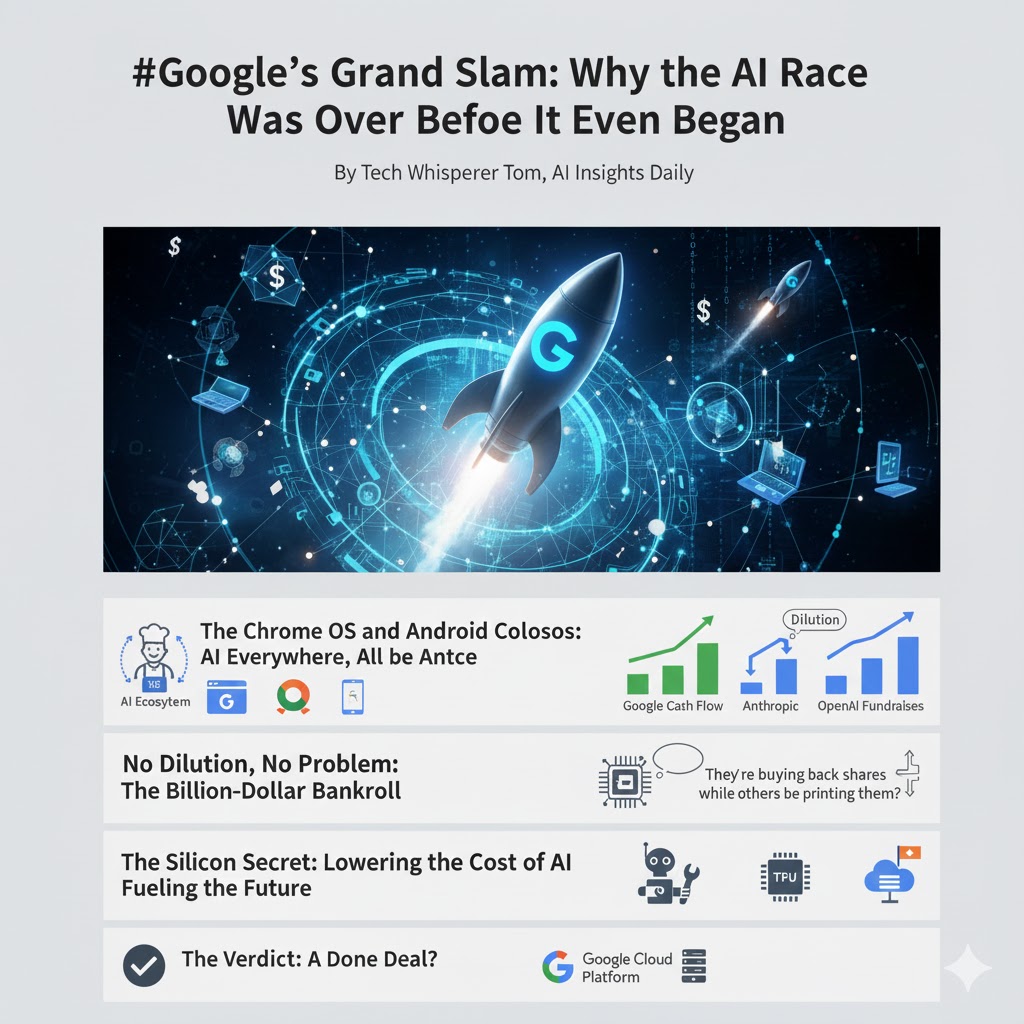
The Chrome OS and Android Colossus: AI Everywhere, All at Once
Imagine a chef who not only invents the recipe but owns all the grocery stores, every kitchen, and the delivery trucks too. That’s Google in the AI era. While rivals scramble for user adoption, Google already has billions of users baked into its distribution network.
“Why did the AI cross the road?” a Google insider quipped. “To get to the other billion users already on Chrome, Android, and Google Search!”
Indeed, the integration of Gemini directly into products like Chrome, Workspace, and Android means Google isn’t just offering an AI; it’s embedding intelligence into the digital fabric of our daily lives. Every search query, every email composed, every document drafted within the Google ecosystem becomes a potential touchpoint for Gemini. This isn’t just distribution; it’s ubiquitous presence, a strategic advantage no startup, however brilliant, can replicate overnight. It’s like having a private highway to every user’s brain, while competitors are still stuck in rush-hour traffic on local roads.
No Dilution, No Problem: The Billion-Dollar Bankroll
While Anthropic and OpenAI are constantly passing the hat, engaging in multi-billion-dollar fundraises that dilute early investors and cede chunks of their company, Google is simply funding itself. With a staggering $385 billion in revenue (TTM) and rivers of free cash flow, Google doesn’t need to ask for permission or compromise its long-term vision.
“Google isn’t raising capital; it’s raising the bar,” joked a Wall Street analyst. “They’re buying back shares while others are printing them. It’s like watching a marathon where one runner has an endless supply of energy drinks and the others are constantly stopping to beg for water.”
This financial self-sufficiency allows Google to invest deeply and consistently, impervious to the whims of venture capitalists. It fosters a culture of long-term research and development, rather than chasing the next funding round.
The Silicon Secret: Lowering the Cost of AI Domination
Building and training frontier AI models is notoriously expensive. We’re talking data centers consuming enough power to light small cities. But here’s where Google plays 4D chess: they build their own chips.
With custom-designed Tensor Processing Units (TPUs), Google drastically reduces the astronomical costs associated with AI computation. While competitors are buying expensive GPUs from external vendors, Google is essentially printing its own money – or rather, its own silicon – optimizing hardware and software in tandem for maximum efficiency. This isn’t just a cost saving; it’s a strategic weapon that allows them to iterate faster, train larger models, and experiment more freely than anyone else.
Imagine trying to win an F1 race when your competitors have to buy their engines from a third party at a premium, while you’re designing and manufacturing your own, perfectly tuned for your car.
The Cloud Computing Juggernaut: Fueling the Future
And finally, the often-underestimated powerhouse: Google Cloud Platform (GCP). While Amazon Web Services (AWS) and Microsoft Azure dominate much of the cloud market, GCP is growing fast, and more importantly, it’s becoming the AI-first cloud.
GCP isn’t just a hosting service; it’s an AI development playground, offering cutting-edge tools and infrastructure that leverage Google’s own AI expertise and TPUs. This means that as more businesses adopt AI, they’re increasingly turning to GCP, further entrenching Google’s position as the foundational layer of the AI economy. It’s a virtuous cycle: Google builds the best AI, which attracts users to its cloud, which in turn generates more data and resources to build even better AI.
More Florida Business News:
• The Expense of Firing Employees
• Duke Energy Sparks Innovation: Groundbreaking Transmission Training Center in Central Florida
• Public Relations Firm in Miami Florida
• WSHC+B Adds Three New Attorneys to Gainesville Office
The Verdict: A Done Deal?
While the “AI Race” narrative makes for compelling headlines, the reality on the ground points to a different conclusion. Google’s strategic advantage in distribution, financial independence, vertically integrated hardware, and a booming cloud business creates a moat around its AI ambitions that few, if any, can cross.
So, as the industry continues to marvel at the latest AI breakthroughs, remember who built the tracks, owns the trains, and is setting the destination. The AI race may have just crowned its champion, and their name is Google.