The Day the Engine Died: How Electric Vehicles Ruined Performance Cars Forever
A Eulogy for Noise, Drama, and Everything That Made Sports Cars Worth Caring About
There’s a smell that used to accompany greatness. A raw, intoxicating cocktail of burning rubber, high-octane fuel, and mechanical fury that told your primitive lizard brain something extraordinary was happening nearby. That smell is gone now. In its place: silence. The soft, antiseptic hum of progress. The sound of a future nobody in a leather driving glove asked for.
Welcome to the Electric Age of Performance Cars, where 0-to-60 times have become absurd, horsepower figures have become meaningless, and somewhere in automotive heaven, Enzo Ferrari is staring into his espresso wondering where it all went so catastrophically wrong.
A Brief Moment of Reverence for What We’ve Lost
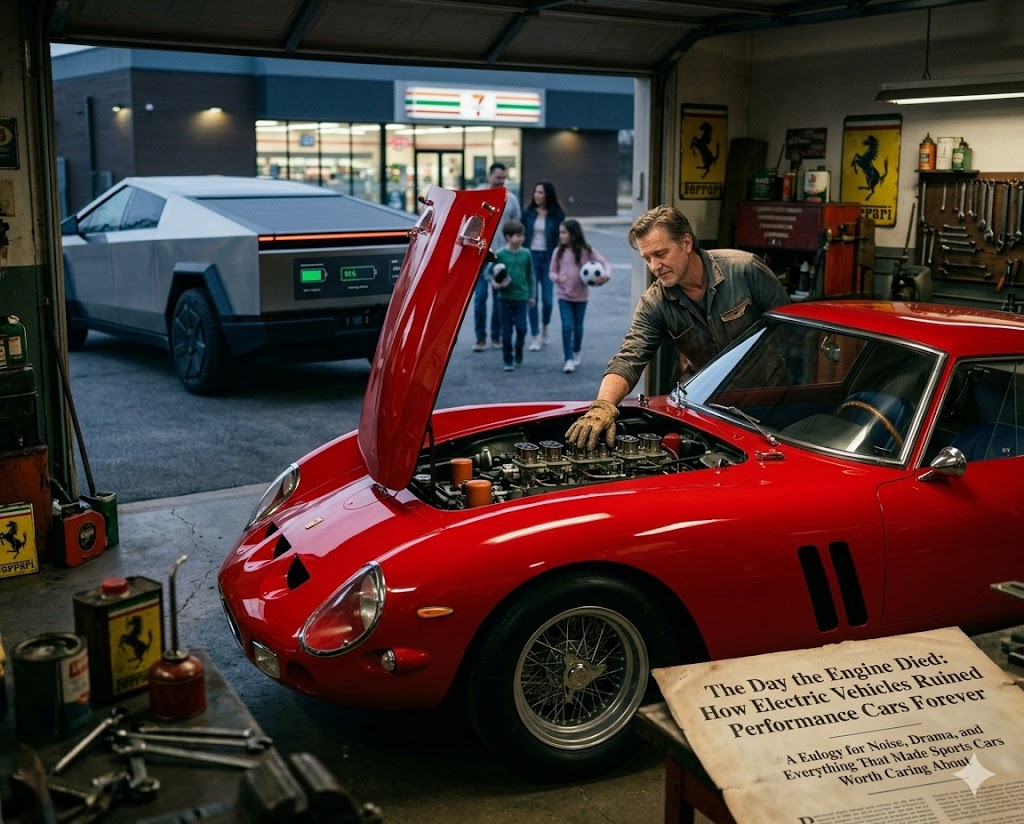
Let us pause and consider the 1962 Ferrari 250 GTO. Three hundred horsepower. A 3.0-liter V12 that screamed like an operatic soprano being chased by wolves. This was a machine that demanded everything from its driver — skill, courage, mechanical sympathy, and frankly a decent life insurance policy. It was temperamental, beautiful, dangerous, and achingly alive. Racing one required talent honed over years. Simply starting one required a degree of automotive literacy that most people today couldn’t manage without a YouTube tutorial.
That car was the pinnacle of human engineering achievement. Drivers like Phil Hill and Stirling Moss wrestled these machines around circuits at speeds that turned spectators’ hair white. The 250 GTO was so technically advanced, so breathtakingly sophisticated for its era, that it changed what people believed a car could be.
Today, that same 300-horsepower Ferrari — a machine that belongs in a museum, that sold at auction for $48 million, that represents the absolute apex of mid-century performance engineering — would get absolutely destroyed in a straight-line drag race by a Tesla Cybertruck.
A refrigerator with wheels.
A stainless-steel brutalist toaster that looks like it was designed by a nine-year-old who just discovered Minecraft. A vehicle so aesthetically offensive that it makes a doorstop look aerodynamic. A machine with all the visual charisma of a loading dock, driven to soccer practice by people who consider themselves visionaries.
That Cybertruck, the one that looks like it fell off a spacecraft and landed in a Costco parking lot, would humble the most celebrated sports car of the twentieth century without even trying. It would do it quietly. Effortlessly. Soullessly. And that, dear reader, is the problem.
The Democratization of Speed (Nobody Asked For)
Here’s what the electric vehicle evangelists don’t tell you in their breathless press releases and TED talks: going fast used to mean something.
Speed was a language. A 600-horsepower naturally aspirated V10 didn’t just move a car — it communicated. It told you, in no uncertain terms, exactly what it was doing and precisely how close to the limit you were operating. The throttle response, the exhaust note, the vibration coming through the steering wheel, the way the chassis loaded up under braking — all of it was information, poetry written in physics, a conversation between man and machine conducted at ten-tenths.
Electric motors have exactly one thing to say: NOPE. Instant torque, instant silence, instant irrelevance of everything you practiced in a parking lot at seventeen years old learning to heel-and-toe downshift.
You want 1,000 horsepower? Here, have 1,000 horsepower. You want 1,500? Sure. You want 2,000? Rimac will sell you some. The numbers have become so enormous they’ve looped back around to meaningless. When a family SUV from Porsche can out-accelerate a 1990s Formula One car, what exactly are we celebrating? What skill is being demonstrated? What triumph of human ability over mechanical challenge is being expressed when you press a pedal and software does absolutely everything?
The answer is none. You’re not driving. You’re being transported. There’s a difference, and the automotive industry has decided you’re not sophisticated enough to care about it.
The Noise Problem (It’s Not a Small Problem)
Let’s talk about what has been ripped from us without so much as an apology: sound.
The wail of a Ferrari V12 at 8,000 RPM is not merely a byproduct of combustion. It is the point. It is why people lined fences at Monza in the 1960s and wept openly like they were witnessing a religious experience, because they were. The sound of a Porsche 911 flat-six howling toward its redline is not noise pollution — it is culture, compressed into audio form and delivered at frequencies that rearrange your internal organs in a deeply satisfying way.
Electric cars sound like a dentist’s drill attached to a golf cart. They sound like disappointment wearing a Tesla badge. The manufacturers know this, which is why several of them have started programming fake engine sounds into their electric sports cars. Artificial noise. Synthesized drama. Pre-recorded passion piped through the speakers like a laugh track on a sitcom, designed to convince you that you’re experiencing something real when you are, in fact, experiencing the automotive equivalent of a theme park ride.
This is where we are. This is what progress looks like. A car that makes fake vroom noises so its driver doesn’t feel like they’re operating an appliance.
The Weight Problem (It Is Also Not a Small Problem)
Physics, that cruel and undefeated champion, has not been consulted about the electric performance car revolution and is frankly furious about being left out of the conversation.
Batteries are heavy. Extraordinarily, stubbornly, physics-defyingly heavy. The battery pack in a Tesla Model S Plaid weighs approximately 1,200 pounds on its own. The entire 1962 Ferrari 250 GTO weighed about 1,900 pounds. Total. Including the engine, the chassis, the body, the driver, and whatever emotional baggage they brought to the circuit that day.
This is why modern electric hypercars, despite their ludicrous power figures and face-rearranging acceleration, handle like shopping trolleys on anything other than a perfectly flat drag strip. They are fast in a straight line with the enthusiasm of a golden retriever and the finesse of a forklift. Put them on a real circuit with elevation changes, camber, and the kind of corners that require actual driver input and mechanical balance, and the laws of physics politely but firmly collect their debt.
The Rimac Nevera makes 1,914 horsepower and weighs 4,740 pounds. The original McLaren F1, which held the title of world’s fastest production car for twelve years, made 627 horsepower and weighed 2,509 pounds. The F1 required a genius-level engineer as a passenger and a driver of near-supernatural ability to operate at the limit. The Nevera requires a driving license and a functioning right foot.
Progress, apparently, means making things faster while removing every conceivable reason to feel proud of going fast.
The Supercar Identity Crisis
Ferrari. Lamborghini. McLaren. Porsche. Names that once meant something specific: danger, passion, mechanical artistry, and the very real possibility that if you weren’t paying attention, the car would kill you and feel no guilt whatsoever about it.
These brands are now, to varying degrees, electrifying. Ferrari launched a hybrid. Lamborghini has gone hybrid. McLaren is going electric. Porsche — glorious, stubborn, flat-six-worshipping Porsche — sells more Taycans than 911s.
The Taycan is a fine automobile. It is quick, refined, and impressive in the way that a very good spreadsheet is impressive: technically accomplished, emotionally inert. It does not make your heart race. It does not make you nervous. It does not whisper darkly to you at a traffic light that it has secrets you are not yet qualified to know.
It just goes. Fast. Quietly. Like a very expensive elevator.
The supercar, by definition, was supposed to be excessive, irrational, and slightly terrifying. It was supposed to be the mechanical embodiment of the id — all want, all sensation, zero practicality. The electric supercar is instead a triumph of the ego: look what I can afford, look how fast it goes, look at how little it costs me in fuel. It is performance as status symbol, entirely divorced from the act of driving itself.
A Final Word to the Refrigerator
So here we are. The 250 GTO sits in a garage somewhere, insured for more than most people earn in a lifetime, its V12 cold and silent, waiting for someone with enough mechanical courage to fire it up and take it somewhere it can breathe.
Meanwhile, the Cybertruck lumbers past in a Whole Foods parking lot, its stainless panels reflecting a world that traded soul for statistics, drama for data, and the glorious, terrifying, irreplaceable scream of a high-revving combustion engine for the smug, frictionless silence of pure, soulless torque.
The internal combustion sports car is not merely dying. It has been murdered, quietly and efficiently, by the very progress it inspired. And the worst part? The killer is faster. It always will be.
The refrigerator wins.
God help us all.
The author acknowledges that electric vehicles are better for the environment, more efficient, technologically remarkable, and almost certainly the future. The author remains inconsolable about this.
• Florida Child Injury Law Firm Justice for Kids
• Why Texas Tops the List: Best State to Launch Your Business in 2024
• Florida Volleyball Triumphs Over Northern Colorado
• The Boy Who Cried Crash: Why Market Prophets Keep Getting It Wrong
• Helene’s Fury: Monstrous Hurricane Barrels Toward Florida’s Vulnerable Coast
About the Author

Brian French is the CEO of Florida Website Marketing and Florida AI Agency. For over 15 years, Brian served as an Internet Marketing Professional for BoardroomPR, one of Florida’s largest public relations firms. He is a specialist in local SEO, AEO, and AI-driven marketing strategies tailored for the Florida business landscape. Connect with Brian on LinkedIn Visit his websites FloridaWebsiteMarketing.com and FloridaAIAgency.com or text him at 813 409-4683 for a consultation.