The Universe’s One Rule — and the Mountain That Holds the Key
Cosmology · Technology · First contact
By Brian French | March 4, 2026
The universe runs on a very short list of rules. One of them may explain why advanced civilizations are so rare — and why a mountain in North Carolina holds the key to whether we become one.
Begin with a question that has haunted scientists for decades.
The universe is 13.8 billion years old. It contains an estimated two trillion galaxies. Each galaxy holds, on average, hundreds of billions of stars. Around many of those stars orbit planets — rocky planets, scientists now know, built from the same elemental recipe as Earth. The numbers are so astronomical that even if only one in a trillion of those planets developed intelligent life, the cosmos should be teeming with civilizations far older and more advanced than ours.
So where is everyone?
Physicists call this the Fermi Paradox, named after Enrico Fermi, who first asked it over lunch in 1950. In seventy-five years, no one has answered it. But a discovery being made right now — about chemistry, about physics, about the terrifying specificity of what it takes to build a microchip — suggests a possibility so strange it sounds like science fiction.
What if the bottleneck isn’t intelligence?
What if it’s geology?
Part I
The Universe’s Periodic Table Is Everyone’s Periodic Table
Here is something remarkable that most people never think about: the periodic table of elements is not a human invention. It is a discovery. The 118 elements it contains are not arbitrary — they are the only atoms that the laws of physics permit to exist. Anywhere. In the entire universe.
An alien civilization ten billion light-years away, orbiting a star in a galaxy we will never see, is built from the same periodic table you learned in high school chemistry. Hydrogen, helium, carbon, oxygen, silicon, iron. The same. Always the same. Physics doesn’t negotiate.
We know this not from theory alone, but from direct observation. For over a century, astronomers have been pointing spectrographs at the light coming from distant stars and galaxies — instruments that split light into its constituent wavelengths like a prism splitting sunlight into a rainbow. Every element, when heated to plasma, emits a signature pattern of light frequencies as unique as a fingerprint. Hydrogen has its signature. Iron has its signature. Silicon has its signature.
And the signatures match. Everywhere we look. The iron in the Andromeda Galaxy, two and a half million light-years away, is the same iron as the iron in your blood. The silicon in a star 50,000 light-years from here is the same silicon as the silicon in the sand on the beach you walked last summer. NASA’s Chandra X-ray Observatory has mapped oxygen, silicon, sulfur, calcium and iron blasted outward from exploded stars across our galaxy — the same atoms, the same physics, cooked in stellar furnaces and scattered across the void.
“The hydrogen in your body came from the Big Bang. The carbon in your body was made by nuclear fusion in the interior of stars. The iron in your body was forged during supernova explosions. We are, quite literally, made of star stuff.”— Carl Sagan
The story of the elements begins 15 minutes after the Big Bang, when hydrogen and helium coalesced out of the cooling fireball. These two elements still make up 98% of everything in the universe. The rest — every other element on the periodic table, every atom of carbon, silicon, oxygen, gold, and uranium — was forged later, inside stars, across billions of years of nuclear fire.
Stars are nuclear furnaces. In their cores, hydrogen fuses into helium, helium into carbon, carbon into oxygen and neon, all the way up the periodic table to iron. Iron is where the fusion chain hits a wall — it costs more energy to fuse iron than it releases, so the star can go no further. The core collapses. The star explodes in a supernova, scattering its hard-won elements across light-years of space, seeding the next generation of star systems with chemical complexity.
The elements heavier than iron — gold, platinum, uranium — require something even more violent: two neutron stars colliding. When that happens, in a cataclysm that releases more energy than most supernovas, the rapid-process neutron capture builds the heavy elements in milliseconds. We have detected this happening. In 2017, gravitational wave observatories confirmed the collision of two neutron stars, and spectroscopes watching the aftermath identified a dozen heavy elements being forged in real time. Gold. Platinum. Strontium.
The periodic table, it turns out, is a record of violence. Every atom heavier than helium was made in stellar fire and catastrophe. And every planet in the universe that forms from the remnants of those stars inherits the same elemental legacy.
Which means any rocky planet, anywhere in the universe, is made primarily of the same things Earth is: silicon and oxygen. The silicates — silicon dioxide in all its forms — are the bones of rocky worlds everywhere. There is no version of a terrestrial planet that isn’t mostly built from silicon and oxygen. Physics won’t allow it.
Recent evidence has made this even more concrete. In 2024, astronomers using the Gemini South telescope studied an ultra-hot gas giant called WASP-189b, 320 light-years from Earth. The planet’s dayside is so hot — over 5,500 degrees Fahrenheit — that its rocky interior vaporizes into its atmosphere, making the planet’s composition readable by spectroscopy. What did they find? The magnesium-to-silicon ratio in the planet’s atmosphere precisely mirrors that of its host star — confirming that rocky planets inherit their elemental composition directly from the stellar nursery that formed them. The universe, it appears, is consistent to a degree that is almost eerie.
Part II
Are There Elements We Don’t Know About?
At this point, a question has probably formed itself: what if there are elements elsewhere in the universe that we haven’t discovered? Elements beyond the 118 on our periodic table? Substances with properties we can’t imagine, capable of things our physics doesn’t predict?
It is a seductive idea. Science fiction has built entire civilizations on it. But the physics is unforgiving.
Each element is defined by one thing and one thing only: the number of protons in its nucleus. Hydrogen has one. Helium has two. Carbon has six. Silicon has fourteen. The properties of every element — how it bonds, how it behaves, what it can build — flow entirely from that proton count. The rules that govern this are quantum mechanics, and quantum mechanics appears to be the same everywhere in the observable universe. The same atomic constants, the same spectral lines, the same physics.
Beyond element 92 (uranium), nuclei become so large and unstable that they decay almost instantly. Elements 93 through 118 have been created in laboratories on Earth for fractions of a second before vanishing. There are theoretical “islands of stability” predicted by nuclear physics — heavier elements that might be stable enough to exist briefly — but none have been found, and their properties, even in theory, would not produce the kind of stable chemistry needed to build a civilization.
The universe’s chemistry is fixed. Everywhere. For all time.
Which means that any alien civilization anywhere in the cosmos — any species that evolved on a rocky planet orbiting a middle-aged star — is working with the same 92 naturally occurring elements we have. The same silicon. The same oxygen. The same iron. The same gold.
And if they ever developed anything resembling our technology, they ran straight into the same wall we did.
Part III
The Wall Every Civilization Must Hit
Consider what it takes to build a microchip.
Not a transistor. Not a circuit board. A modern microchip — the kind that runs an AI, guides a missile, processes a genome, or enables the communication infrastructure of a civilization. The kind that makes a species genuinely powerful.
At its heart, a microchip is silicon. Pure silicon. Not the silicon in beach sand or window glass. Silicon refined to a standard of purity that has no parallel in the entire history of material science. A standard that took humanity decades of effort, billions of dollars, and one very specific geological accident to achieve.
The standard has a name in the industry. They call it eleven nines.
99.99999999999%
For every trillion atoms, fewer than ten are anything other than silicon. It is the cleanest substance ever manufactured. And making it requires a very specific vessel: a crucible of fused quartz that can hold molten silicon at 1,425 degrees Celsius without contributing a single stray atom to the melt. Not one. The crucible must be, in its own way, almost as pure as the silicon itself.
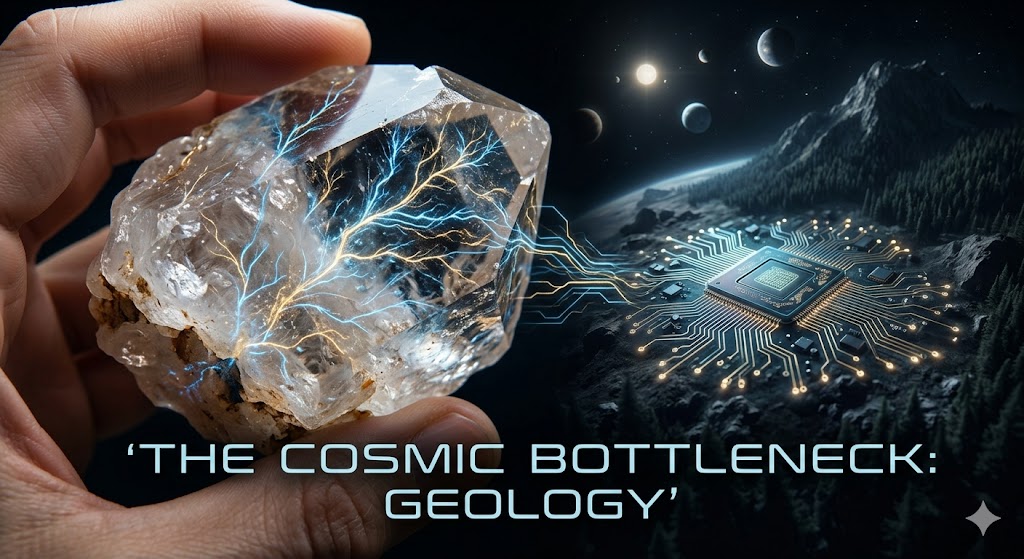
And here is where the physics of the universe collides with the geology of one specific planet, in one specific solar system, on one specific mountain in the Appalachian Mountains of North Carolina.
To make that crucible, you need quartz — silicon dioxide — of extraordinary purity. And the only place on Earth where quartz of sufficient purity can be found in industrial quantities is a valley in Mitchell County, North Carolina, called Spruce Pine.
Not nearly pure. Not close enough. The only place.
Seventy to ninety percent of the world’s supply of ultra-high-purity quartz — the material that makes semiconductor manufacturing possible — comes from two mines at the end of a two-lane road in a town of 2,000 people that almost no one has ever heard of. When Hurricane Helene flooded those mines in the fall of 2024, alarm signals propagated silently through the global semiconductor supply chain. Behind closed doors, executives from Seoul to Phoenix asked the same question: if those mines don’t reopen within three months, what happens to the chips? The answer was: production slows. Then stops.
The Spruce Pine quartz is extraordinary for a reason that took 380 million years to arrange. When ancient Africa collided with ancient North America, it created an underground collision zone of extreme heat and pressure — but crucially, almost no water. Water introduces impurities into crystallizing rock and locks them in permanently. The Spruce Pine quartz formed dry, and its uniquely open crystalline structure allows acid to be injected directly into the crystal lattice, scrubbing out the last traces of contamination. No other naturally occurring quartz deposit on Earth has this property in the quantities required.
Geologists have spent careers looking for a comparable deposit. They have not found one.
Part IV
The Question That Should Keep You Awake
Now hold all of this in your mind at once.
The universe runs on universal chemistry. Every rocky planet in every solar system in every galaxy is built primarily from silicon and oxygen — the same elements, the same physics. Any civilization advanced enough to develop computers must, by the laws of nature, refine silicon to extreme purity. To refine silicon to extreme purity, they need an ultra-pure quartz crucible. To make that crucible, they need a geological accident of extraordinary specificity: a tectonic collision that happened dry, at exactly the right pressure, in exactly the right formation, over exactly the right timescale.
The question is: how common is that accident?
On Earth, it happened once. One valley. On a planet that has been geologically active for 4.5 billion years, with plate tectonics churning continents into and apart from each other in countless collisions across deep time — it produced exactly one deposit of sufficient purity. One.
Perhaps on other worlds, the equivalent deposit is more common. Perhaps their geology is more generous. Perhaps somewhere in the Milky Way, a civilization found their version of Spruce Pine on the first try and sailed smoothly into the semiconductor age without ever realizing how lucky they were.
Or perhaps they didn’t. Perhaps the geological lottery is rigged against complexity. Perhaps the universe is full of intelligent species who got tantalizingly close to advanced technology — who understood the physics, who could see the path forward — but whose planets never produced the one specific geological formation needed to cross the threshold. Not because they weren’t smart enough. Because their mountain wasn’t built right.
The Fermi Paradox asks: where are all the aliens? One answer, perhaps the darkest answer, is this: they are exactly where we almost were in September 2024, standing at the edge of the silicon age, unable to cross.
Part V
What This Means for Us
The same elements exist everywhere. The same physics operates everywhere. The same chemistry is possible everywhere. And the same bottleneck exists everywhere.
Which makes what’s sitting in that mountain in North Carolina something more than a mining story. It is a cosmic fluke — a geological accident so specific that it borders on miraculous — that gave one species on one planet the ability to do what may be extraordinarily rare in the universe: build chips. Build AI. Build a technological civilization capable of reaching for the stars.
The companies that know this are investing $700 million to expand those mines. North Carolina lawmakers have passed legislation barring China and Russia from ever acquiring them. The deposit has more than 100 years of reserves remaining. Edison used material from this same mountain to insulate his first electrical inventions in 1879, and the mountain has been feeding every technological revolution since, in almost complete silence.
The universe handed us 92 elements and the same rules it gave everyone else. What it also gave us, by a geological accident 380 million years ago in the Blue Ridge Mountains, was the one thing those rules demand before a civilization can truly begin.
Out there, in the two trillion galaxies we can see, there may be other species looking up at the same stars, working with the same periodic table, dreaming of the same technology. Some of them may be searching their world’s mountains for a deposit like Spruce Pine’s. Some may never find it. We found ours. We almost didn’t understand what we had until a hurricane nearly took it away. That is the most important thing a civilization has ever almost lost that it never knew it was about to lose.
The universe runs on physics. Physics demands silicon. Silicon demands eleven nines. Eleven nines demands one very specific mountain.
Ours is in North Carolina. On a road that doesn’t look like anything.