The Curious Case of the eBay Victory Lap: When $70 Profit Isn’t Exactly a Flex
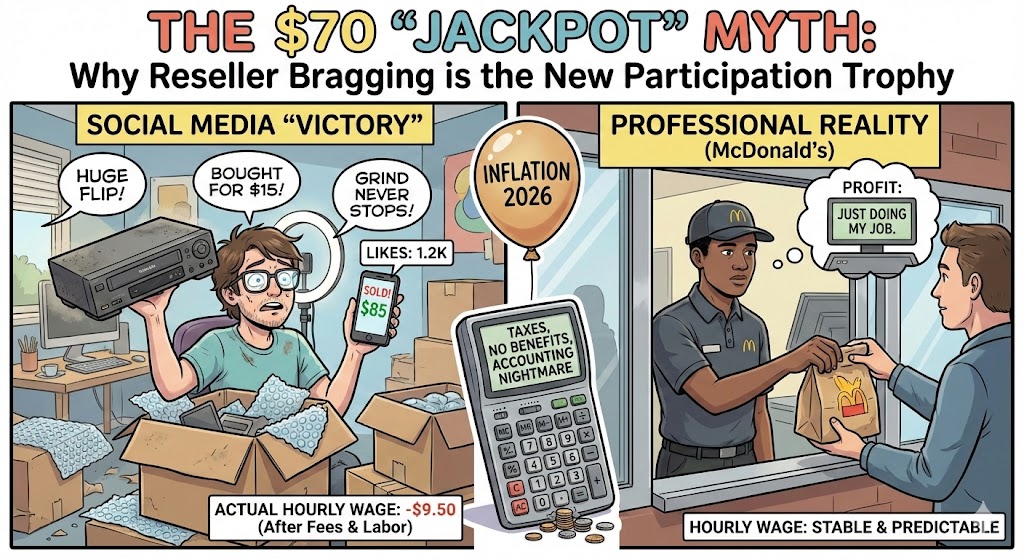
There’s a peculiar ritual playing out across YouTube channels and Facebook groups that would baffle anthropologists: grown adults celebrating the sale of used goods with the enthusiasm typically reserved for lottery winners or new parents. Welcome to the world of eBay reselling, where someone flipping a thrift store find for a $70 profit receives the same adulation others might expect for curing a disease.
“MASSIVE PROFIT ALERT!” screams the YouTube thumbnail, featuring a wide-eyed reseller holding up a dusty ceramic figurine like Simba on Pride Rock. “Bought for $15, sold for $85!” The comments section erupts: “You’re crushing it!” “Teach me your ways, master!” “Goals!”
Meanwhile, the 19-year-old working the lunch rush at McDonald’s has assembled approximately 47 Big Macs in the same hour, generating thousands in revenue for his employer, and you know what he’s not doing? Creating a 23-minute YouTube video with dramatic B-roll about his “insane flip.”
The Unglamorous Math of “Killing It”
Let’s walk through what actually happened with that celebrated $85 sale, shall we? Because when you break down the reselling process into its component tasks and assign even minimum wage to each step, that victory lap starts looking more like a participation trophy.
The Reselling Gauntlet: A Partial Inventory
- Sourcing (2-4 hours): Driving to thrift stores, estate sales, or garage sales. Parking. Walking. Scanning. Researching comparable sales on your phone while other shoppers judge you. Debating whether that Precious Moments figurine is ironic enough to be valuable again.
- Due Diligence (30 minutes): Checking sold listings, not just active listings (rookie mistake). Calculating fees. Estimating shipping costs. Convincing yourself this is definitely not hoarding.
- Acquisition & Transport (30 minutes): Waiting in line. Making small talk with the cashier who thinks you’re buying this stuff for yourself. Loading your car. Unloading your car. Realizing you forgot to check if the vintage radio actually works.
- Testing & Research (45 minutes): Does it work? Are there chips, cracks, or stains? What’s the exact model number? What year was this made? Why are there so many different patterns of Depression glass?
- Cleaning & Prep (1 hour): Removing price stickers without damaging surfaces (an art form). Cleaning. Polishing. Taking that weird smell out. Realizing you need special cleaner you don’t have.
- Photography (45 minutes): Setting up your “photo area.” Finding good lighting. Taking 12 photos from every angle. Retaking them because your reflection is visible in the chrome. Editing. Cropping. Enhancing. Becoming an accidental product photographer.
- Listing Creation (30-45 minutes): Writing a detailed, SEO-friendly title. Crafting a description that’s thorough but not novel-length. Measuring. Weighing. Selecting categories. Adding item specifics. Debating whether “gently used” or “pre-owned” sounds better.
- Customer Service (variable): Answering questions like “What’s your lowest price?” (it’s listed), “Can you send more photos?” (sure), and “Is this still available?” (if it’s listed, yes, that’s how eBay works).
- Packing Materials Procurement (ongoing): Hoarding boxes from every Amazon delivery. Buying bubble wrap, poly mailers, and tape in bulk. Storing all of this in your increasingly cramped living space. Explaining to your spouse that you need that box “just in case.”
- Post-Sale Processing (30 minutes): Printing shipping labels. Packing with care appropriate to the item’s fragility and the buyer’s potential litigiousness. Taping. More taping. Contemplating whether this is enough taping.
- Shipping (30 minutes): Driving to the post office or UPS store. Waiting in line behind someone mailing a package to their grandson with 47 separate instructions. Actually shipping the item.
- Follow-up & Damage Control (variable): Tracking the package. Responding to “Where’s my item?” messages 24 hours after purchase. Dealing with returns. Handling cases where the buyer claims the item was “not as described” because they didn’t read the description.
Let’s be conservative and say this entire process took 10 hours of actual work (and that’s being generous—many resellers would laugh at this estimate). At the current federal minimum wage of $7.25/hour, that’s $72.50 in labor. Your $70 profit just became… -$2.50.
But wait, there’s more!
The Hidden Costs Nobody Puts in Their Thumbnails
Let’s talk about what doesn’t make it into the “EPIC THRIFT HAUL” videos:
eBay fees: Approximately 13.25% on most categories after you factor in the final value fee and payment processing. That’s $11.26 on your $85 sale.
Shipping costs: Even if the buyer paid for shipping, you likely subsidized Priority Mail because eBay’s label discounts aren’t as generous as they seem, and you wanted tracking. Figure $3-5 out of pocket.
Gas: Driving to three thrift stores, the post office, and the packing supply store. In 2025, with gas averaging $3.50+ per gallon, that’s not nothing.
Packing materials: That bubble wrap and box? Not free.
Storage costs: Whether it’s rent on a storage unit or the opportunity cost of turning your spare bedroom into a warehouse, you’re paying for space.
Unsold inventory: For every item that sells, resellers typically have 3-5 items that sit, eventually getting donated back to the thrift store in an ironic circular economy.
Your soul: Intangible, but depreciating.
Suddenly, that $70 gross profit is looking more like $30-40 net, and we haven’t even talked about taxes yet.
The Tax Man Cometh (And He Wants His Cut of Your Beanie Baby Profits)
Here’s the part that really separates the hobbyists from the small business owners: Uncle Sam doesn’t care that you’re operating out of your garage. Once you’re making real money reselling, you’re self-employed, which means:
Self-employment tax: 15.3% right off the top for Social Security and Medicare. On a $50,000 annual revenue (which sounds impressive until you factor in costs), that’s $7,650.
Income tax: Depending on your bracket, another 12-22% or more.
State income tax: In most states, add another 3-7%.
Accounting costs: Either you’re spending dozens of hours doing your own bookkeeping and taxes, or you’re paying a CPA $500-2,000 annually to make sense of your spreadsheets.
By the time you account for all taxes and expenses, reselling experts generally agree you need to be doing $100,000+ in annual revenue to achieve what most would consider a “moderate” middle-class income. And that’s revenue, not profit.
The Benefits Package That Isn’t
Let’s compare the reselling lifestyle to that McDonald’s employee for a moment:
McDonald’s worker gets:
- Hourly wage, guaranteed
- Predictable schedule
- Worker’s compensation if injured
- Possible health insurance (if full-time)
- Possible 401(k) match
- Paid training
- No financial risk
- Someone else deals with angry customers
- Ability to leave work at work
eBay reseller gets:
- Income that varies wildly month to month
- Work that follows them home (it is home)
- Zero paid time off (items don’t list themselves)
- Zero sick days (packages don’t ship themselves)
- Health insurance purchased on the marketplace at eye-watering prices ($500-800/month for individuals in 2025)
- Retirement planning that’s entirely self-funded
- 100% of business risk
- Personally dealing with every nightmare customer
- A spare bedroom filled with ceramic roosters
When you’re lying awake at 3 AM wondering if you’re going to make rent because eBay changed its algorithm and your sales dropped 40%, that Big Mac slinger’s guaranteed $15/hour starts looking pretty sweet.
The 2025 Reality Check: When Middle-Class Feels Upper-Class
Let’s talk about the elephant in the room: inflation has made “making it” as a reseller exponentially harder. In 2025, the costs that seemed manageable five years ago have ballooned:
- Rent/Mortgage: Up 30-40% in many markets. Good luck running a reselling operation out of a storage unit.
- Gas: Remember when $2.50/gallon seemed expensive?
- Shipping: USPS rates increase annually, and “free shipping” is a competitive necessity.
- Sourcing: Even thrift stores have caught on, with Goodwill now looking up values and pricing accordingly.
- Competition: More people reselling means less inventory and lower margins.
To live a middle-class lifestyle in a mid-sized American city—modest house, reliable car, occasional vacation, some retirement savings—you’re looking at needing $60,000-75,000 in take-home income. For a reseller, that means $100,000-150,000 in revenue, after you factor in all the costs we’ve discussed.
Suddenly, that $85 sale is looking less like a victory and more like a rounding error.
The Psychology of the Humble-Brag
So why the constant posting, sharing, and celebrating? Why does someone feel compelled to create a 15-minute video about finding a vintage Nintendo game at a yard sale?
Here’s the uncomfortable truth: when you brag constantly, you’re usually trying to convince someone. Sometimes that person is your audience. Often, it’s yourself.
Real confidence is quiet. The reseller who’s genuinely killing it—pulling in $200,000+ annually, with systems and employees, treating it like an actual business—isn’t making TikToks about individual sales. They’re too busy scaling.
The constant victory laps often signal something else: the need for external validation to justify the hustle. When your parents keep asking when you’re going to get a “real job,” and your friends with corporate careers have health insurance and 401(k)s, and your spouse is getting tired of living in a warehouse, that Facebook post about your “$70 PROFIT!!!” becomes less about celebration and more about reassurance.
See? I am successful. This is working. I’m not just hoarding and calling it a business model.
The Competence Nobody Acknowledges
Here’s the twist: reselling done well actually requires impressive skills:
- Market research and trend analysis
- Logistics and supply chain management
- Photography and marketing
- Customer service and conflict resolution
- Financial planning and accounting
- Time management and systems thinking
- Specialized knowledge across dozens of categories
- The psychological fortitude to deal with eBay’s increasingly seller-hostile policies
A successful reseller is part detective, part photographer, part shipping coordinator, part accountant, part customer service rep, and part therapist (mostly to themselves).
These are real skills. They’re valuable skills. They’re skills that could translate to a corporate role making $60,000-80,000 with benefits.
But posting “HUGE WIN! $12 profit on vintage Tupperware!” to a Facebook group doesn’t showcase those skills. It showcases the need for a pat on the back.
The Path Forward: Treat It Like a Business or Treat It Like a Hobby
There’s nothing wrong with reselling. Done strategically, with appropriate scale and systems, it can be a legitimate business. But that requires:
- Treating it like a business, not a treasure hunt
- Tracking actual profitability per hour, not just gross sales
- Specializing rather than being a generalist
- Investing in systems and possibly help
- Accepting that if you’re making less than you would at a W-2 job with benefits, you’re paying a lot for the privilege of being your own boss
There’s also nothing wrong with reselling as a hobby or side hustle for extra cash. But hobbies don’t usually require YouTube channels celebrating each small win.
The disconnect comes when people treat a hobby-level operation like a business in terms of time and emotional investment but refuse to run the numbers like an actual business. That’s when you end up working 60 hours a week to net $25,000 annually while posting like you’re Gary Vaynerchuk.
A Modest Proposal
Here’s a thought: what if, instead of posting every sale, resellers posted their actual monthly P&L statements? Revenue, cost of goods, expenses, fees, estimated hourly rate after all costs?
The engagement would drop faster than a poorly packaged ceramic shipped via eBay Standard Envelope. Because the truth is often less Instagram-worthy than the fantasy.
Nobody wants to see:
- “Worked 60 hours this week, netted $412 after expenses! That’s $6.86/hour!”
- “Spent 3 hours at an estate sale, bought $200 in inventory, sold $45 of it so far!”
- “Just paid my quarterly estimated taxes. Cried a little!”
But those posts would be honest.
The Bottom Line
If you’re reselling and loving it, genuinely making good money, and feeling fulfilled—fantastic. Legitimately, no sarcasm. Entrepreneurship is hard, and if you’ve cracked the code, congratulations.
But if you’re posting every sale to convince yourself and others that you’re winning while secretly stressed about money, working more hours for less pay than you could earn elsewhere, and living in a house that looks like a thrift store exploded… maybe it’s time for some honest accounting.
The McDonald’s worker isn’t bragging about each Big Mac because they don’t need to. They show up, do their job, get paid, and go home. There’s dignity in that. There’s security in that.
Sometimes the real flex isn’t the sale. It’s having your weekends free, health insurance that doesn’t cost $700/month, and not having to photograph vintage glassware at golden hour for optimal listing performance.
Just something to consider next time you’re tempted to post “SCORED BIG TODAY!” about a $40 net profit that took eight hours to achieve.
Now if you’ll excuse me, I need to go photograph some vintage Pyrex. This article isn’t going to pay for my increasingly expensive health insurance.st