A Comedy in Infinite Acts
Meet the Merchants of Mayhem
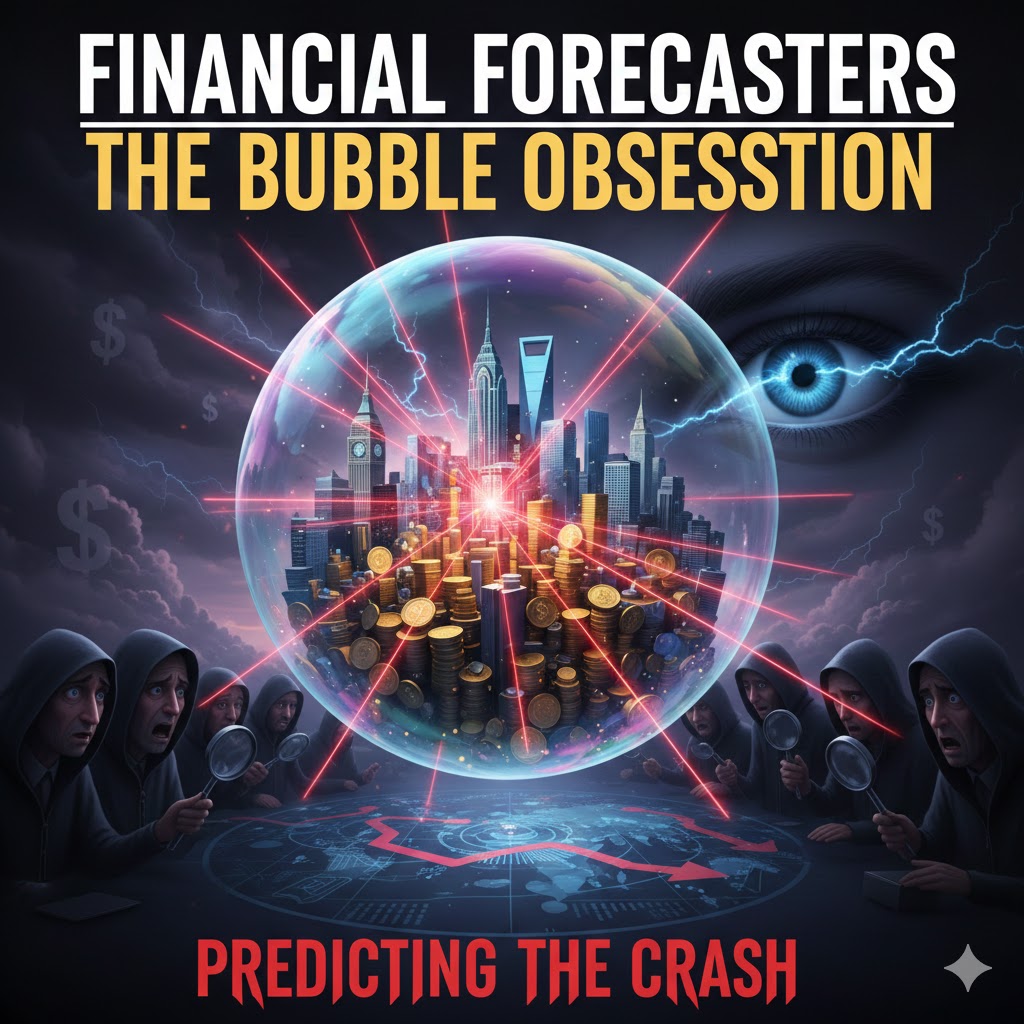
There exists a peculiar subspecies of financial expert whose entire career revolves around shouting “fire” in a crowded theater, except the theater is the stock market, there’s no fire, and they’ve been doing this every Tuesday for forty years. These prophets of profit doom have perfected the art of being spectacularly, consistently, almost impressively wrong—yet somehow they keep getting invited back on CNBC.
Their business model is brilliant in its simplicity: predict catastrophe with the confidence of a carnival fortune teller, wait for the inevitable market hiccup (markets go down sometimes, shocking), then spend the next decade reminding everyone you “called it” while conveniently memory-holing the 247 times you predicted the apocalypse that never came.
It’s like being a weather forecaster who predicts tornados every single day. Eventually you’ll be right, and when that tornado finally touches down, you can spend the rest of your career selling books about that one time you were correct. Never mind that you told people to cancel their outdoor weddings on 3,000 beautiful sunny days.
The Hall of Shame: A Greatest Misses Album
If financial forecasting were baseball, these folks would be batting approximately .003. That’s not a typo. Research shows that professional economic forecasters failed to predict 148 of the 150 recessions that occurred worldwide between 1992 and 2014. At this point, you’d get better economic predictions from a Magic 8-Ball, and the Magic 8-Ball would at least occasionally reply “outlook unclear” instead of always insisting the end is nigh.
Let’s take a trip down memory lane, shall we? After correctly predicting the 2008 crisis (a broken clock moment if ever there was one), some of our favorite doomsayers spent the next fifteen years predicting imminent collapse with the enthusiasm of a six-year-old who just learned the word “catastrophe.”
In 2010, prominent voices warned that quantitative easing would trigger Weimar Republic-style hyperinflation. People were advised to stock up on canned goods and ammunition. Instead, we got one of the longest bull markets in history and inflation that couldn’t even crack 3% for most of the decade. Awkward.
Bitcoin skeptics in 2013 declared with absolute certainty that cryptocurrency would be worthless “within months.” One economist compared it to tulip mania, which would have been a sick burn if Bitcoin hadn’t then proceeded to survive an entire decade of predictions of its imminent demise. It’s like the Kenny from South Park of assets—they keep killing it, but it keeps coming back.
When Trump won in 2016, certain economists predicted immediate market devastation. The market instead rallied. When Brexit passed, experts lined up to explain how Britain would immediately descend into economic chaos. Britain had problems, sure, but “immediate economic chaos” was not among them. Somewhere, these forecasters were furiously recalibrating their crystal balls.
The pattern is so consistent it’s almost reassuring. If you want to know what won’t happen economically, just find out what the perpetual pessimists are predicting and assume the opposite.
Every. Single. Innovation. Same. Script.
Here’s a fun game: pick any transformative technology from the last 200 years. Now imagine the chorus of experts declaring it an unsustainable bubble, a passing fad, or the harbinger of societal collapse. Congratulations, you’ve just predicted history!
When electricity started illuminating homes, concerned experts warned it would cause fires, moral decay, and probably athlete’s foot. The telephone? It would destroy meaningful human connection (to be fair, they might have been onto something with social media, but still). Motion pictures would corrupt youth. Radio would rot brains. Television would create a generation of zombies. Video games would turn children into violent sociopaths. The internet was a fad for nerds and academics that would never catch on commercially.
Each prediction was delivered with utmost seriousness by Very Important People with impressive credentials. Each prediction aged like milk left in the desert sun.
The financial sector followed the same script. Canals were a bubble until they weren’t. Railroads were obviously overvalued speculation until they literally connected the continent. Automobiles? A rich man’s toy that would never replace the reliable horse. (The horse lobby was quite confident about this one.) Electricity utilities, aviation, plastics, semiconductors—every single one faced dire warnings from people who were certain they’d learned the lessons of the last bubble.
The dot-com era gave these folks enough material to dine out on for decades. “Remember the dot-com crash?” they’ll say, eyes gleaming with the satisfaction of someone who finally has evidence for their worldview. “That’s what happens with bubbles!”
Sure, Jan. Pets.com failed. But you know what survived? Amazon. eBay. Google was founded during the crash and became so successful that its name became a verb. The internet didn’t go away—it became the literal infrastructure of modern civilization. But sure, let’s focus on the sock puppet.
Why AI Isn’t Following Your Paint-By-Numbers Bubble Template
Here we are again. New technology, same tired script. “AI is a bubble!” they proclaim, dusting off the same playbook they’ve used for literally every innovation since the steam engine. Except this time—and I know you’ve heard this before, but seriously—it’s different.
Real Money Is Actually Changing Hands (Weird, Right?)
Unlike the dot-com era, where companies with business plans scrawled on napkins commanded billion-dollar valuations based on pure vibes, AI companies are generating actual revenue from actual customers who are actually willing to pay actual money. Revolutionary concept, I know.
GitHub Copilot has over 1.8 million paid subscribers. That’s not “we’re popular at cocktail parties” money. That’s “people are literally opening their wallets” money. Companies using AI for customer service are reporting 30-50% cost reductions. That’s not speculative future value—that’s current quarterly earnings no longer being spent on things.
Drug companies are using AI to discover new compounds in 18 months instead of five years. Unless you think pharmaceutical companies are in the business of throwing billions at technologies that don’t work (actually, okay, bad example), this suggests genuine utility.
The Infrastructure Has Value Even If You’re Wrong
Let’s say, hypothetically, that the bubble boys are right for once and AI crashes tomorrow. You know what we’d still have? A massive global network of high-powered computing infrastructure, advanced chips, and data centers.
Remember when the dot-com bubble burst and critics said all that fiber optic cable investment was wasteful excess? That “wasteful excess” now streams Netflix to your phone while you’re sitting on the toilet. Those overbuilt data centers? They’re running the cloud services that power, well, everything.
NVIDIA’s GPUs, Microsoft’s data centers, Google’s tensor processing units—all of this remains useful even if ChatGPT-53 doesn’t become sentient and solve world hunger. It’s like building roads. Sure, some toll roads fail, but the asphalt is still there, and someone will use it.
Adoption Is Happening Faster Than Your Last Relationship Moved
ChatGPT hit 100 million users in two months. For context, it took Instagram 2.5 years, Facebook 4.5 years, and the iPhone two years to reach that milestone. And unlike your Instagram account with 47 followers, these are actual active users doing actual work.
Enterprise adoption is even more telling. A 2024 survey found 65% of organizations regularly using generative AI, nearly double the previous year. These aren’t teenagers playing with chatbots for fun—these are serious companies with serious budgets doing serious implementations. Unless you think 65% of corporate America suddenly became gullible idiots (okay, fair concern), this suggests real value.
It’s Not One Sector, It’s Everything Everywhere All At Once
Historical bubbles typically had the decency to confine themselves to one sector so we could all watch the trainwreck together. Tulips? Flowers. South Sea Bubble? One company. Dot-com? Internet stocks. Housing crisis? Real estate.
AI is showing up like that friend who invites themselves to every party: healthcare, agriculture, manufacturing, finance, education, entertainment, energy, transportation, logistics, and probably your coffee maker if you wait long enough.
This matters because even if AI disappoints in some applications—say, automated screenwriting produces nothing but Michael Bay movies—success in medical diagnostics or logistics optimization still justifies the technology’s existence. It’s portfolio diversification, but for technological innovation.
The Companies Aren’t Broke College Dropouts In Hoodies
No offense to college dropouts in hoodies (some of our best billionaires started that way), but the companies leading AI development aren’t burning through venture capital hoping to find a business model eventually. Microsoft made $88 billion in operating income last year. Google’s parent company pulled in $84 billion. Apple’s sitting on more cash than some countries’ GDP.
These companies could invest $100 billion in AI research, have it completely fail, and still be more profitable than 99% of companies on Earth. Compare this to Pets.com, which burned through $300 million dollars selling dog food at a loss and hoping to make it up in volume (spoiler: they didn’t).
The Real Cost: Opportunity Lost While Crying Wolf
Here’s the thing that actually matters: when you predict disaster constantly, eventually risk-averse people believe you and sit on the sidelines. And while they’re sitting there feeling smug about avoiding the “bubble,” the market doubles. Then triples. Then they retire with less money than they would have had if they’d just ignored the prophets of doom.
Anyone who listened to bubble warnings in 2010 and avoided tech stocks missed over a decade of returns that would make a venture capitalist weep with joy. Those who were convinced cryptocurrency was definitely, absolutely, 100% going to zero missed opportunities for life-changing gains. (And yes, also opportunities for life-changing losses, but that’s kind of how risk works.)
The broader damage is worse. If every innovation is labeled a bubble, capital becomes scarce for genuinely transformative ventures. Investors get spooked. Companies become conservative. Policymakers regulate out of fear. And innovation slows not because the technology lacks merit, but because everyone’s terrified of being the idiot who bought tulips.
It becomes a self-fulfilling prophecy, except in reverse: instead of talking ourselves into a bubble, we talk ourselves out of progress.
How To Spot The Difference Between Skepticism And Professional Pessimism
Look, we’re not saying you should invest your life savings in every startup with “AI” in the name and a slick PowerPoint. That would be stupid. Some AI applications will fail. Some companies will disappoint. Some use cases will prove less revolutionary than promised.
Healthy skepticism asks good questions: What specific problem does this solve? Who’s paying for it? What’s the competitive moat? Are the unit economics sustainable? How does this scale?
Professional pessimism, by contrast, starts with “this is a bubble” and works backward to justify that conclusion. It cherry-picks examples (remember Pets.com?!), ignores evidence (but those revenues don’t count because reasons), and treats every new thing as inherently suspect.
The difference is whether you’re trying to understand reality or trying to be the person who gets to say “I told you so” at cocktail parties.
The Audacity Of Human Progress
Here’s what the perpetual pessimists consistently miss: humans are annoyingly good at making useful things. Yes, we occasionally get overly excited and create speculative excess. Yes, markets sometimes overshoot. Yes, not every company succeeds.
But the arc of technological progress bends toward “actually this was pretty useful and created enormous value.” The printing press, steam engine, electricity, telephone, automobile, airplane, computer, internet—every single one disrupted existing industries, sparked speculation, triggered warnings of doom, and ultimately proved transformative.
AI sits squarely in this tradition. It’s not a magic solution to everything. It won’t cure cancer, solve climate change, and achieve world peace by next Tuesday. But it is demonstrably improving productivity across multiple sectors right now, today, in measurable ways.
The professional catastrophists will continue their warnings because that’s their job. They’ll point to every stumble as validation (“see, I told you!”) and dismiss every success as temporary or fraudulent (“just wait, the real crash is coming!”). They’ll be wrong far more often than right, just as they’ve always been.
And when the next transformative technology emerges—quantum computing, fusion energy, brain-computer interfaces, whatever—they’ll dust off their bubble playbook and start the whole performance over again. It’s a perpetual motion machine of pessimism.
The Final Word: Ignore Them
The track record is clear. The data is unambiguous. The pattern is consistent. Betting against transformative technology because someone on TV predicts disaster is like declining to board an airplane because you heard about a crash once.
Yes, planes occasionally crash. Yes, markets occasionally correct. Yes, some innovations disappoint. But the overwhelming evidence of human history suggests that genuinely useful technologies succeed despite temporary setbacks, speculation, and the dire warnings of people who’ve built careers on being wrong.
AI will stumble. Companies will fail. Valuations will correct. And through it all, the technology will continue improving, costs will continue falling, applications will continue expanding, and value will continue being created.
The doomsayers will still be there, predicting the crash that’s definitely coming next quarter. They’ll be wrong, as usual. But that won’t stop them from showing up on financial television to explain why this time, finally, they’re right.
Meanwhile, the rest of us can get back to using AI to do useful things, building companies that create value, and generally participating in the ongoing miracle of human innovation that’s been happening despite the naysayers for the last several thousand years.
The sky isn’t falling. It never was. And that, more than anything, seems to really annoy the people whose entire careers depend on convincing you otherwise.
Now if you’ll excuse me, I need to use AI to help me write my next article predicting that professional pessimists will continue to be wrong. The irony is not lost on me.