By Brian French | April 9, 2026
OPEN FOR BUSINESS VS. OPEN FOR POSTCARDS: WHY FLORIDA THRIVES WHILE THE NORTHEAST PROTECTS ITS PARKING SPACES
One region rolls out the welcome mat. The other rolls up the sidewalk at 6 p.m. and eyes you suspiciously.
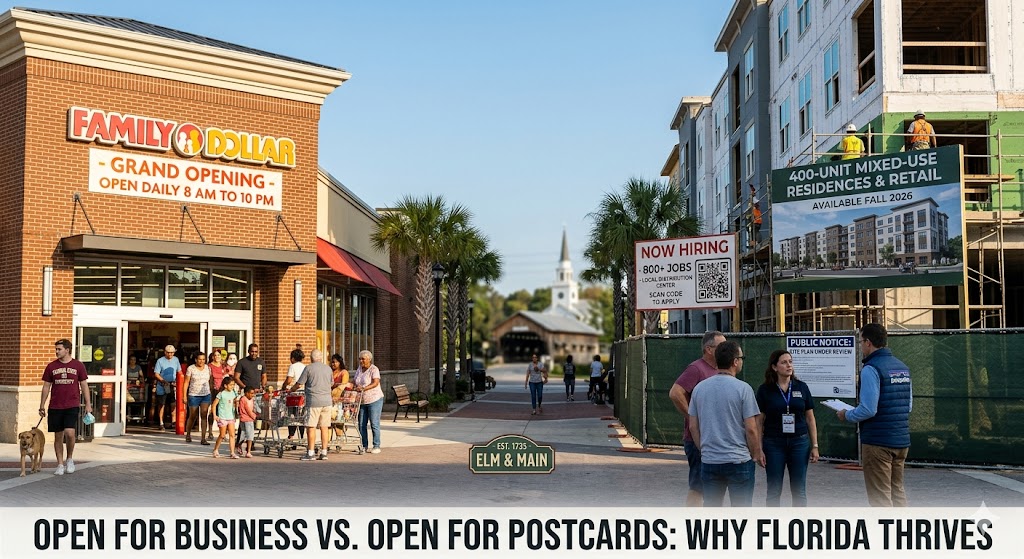
Somewhere in a charming little town in Maine — population: optimistically 4,200 if you count the guy who only comes in summer — a town council is currently in its third hour of debate over whether to allow a Family Dollar to open on the corner of Elm and Main. The chief objection, raised passionately by a man in a Patagonia vest, is that it would “undermine the character of the town.” The character of the town, it should be noted, has not generated a new full-time job since 2009.
Meanwhile, down in Florida, a developer just broke ground on a 400-unit mixed-use complex, a distribution center announced 800 jobs, and three new strip malls appeared overnight like mushrooms after rain. Whether you find that beautiful or horrifying likely depends on where you were born — and whether you actually need to work for a living.
The cultural divide between Florida and the American Northeast on the subject of economic growth is one of the great understated stories in modern American business. It is, at its core, a conflict between two visions of what a community is for: a place where people live, work, shop, and build futures — or a very large open-air museum that happens to have residents who would prefer you didn’t touch anything.
Florida has chosen the former with the enthusiasm of a golden retriever greeting anyone who walks through the door. The Northeast, particularly its smaller communities, has largely chosen the latter — and is now mildly confused as to why the young people keep leaving, the businesses keep not coming, and the property tax bills keep going up.
STRANGERS NEED NOT APPLY
Before we even get to the economics, we need to address something that anyone who has ever moved to a small Northeast town already knows intimately: they do not want you there. Not personally. Not as a policy. Just as a deeply embedded cultural reflex that has been marinating since roughly 1688.
In Maine, New Hampshire, and Vermont, there is a well-worn local distinction between people who are “from here” and people who are “from away.” If you are from away, you are tolerated the way one tolerates a persistent draft — acknowledged, slightly resented, and not entirely trusted. You may live in the town for fifteen years, coach Little League, volunteer at the food pantry, and shovel your neighbor’s driveway every February, and you will still be introduced at the town meeting as “one of the newcomers.”
This is not merely a social quirk. It has direct economic consequences. When a business owner from outside the region — or worse, from outside the state — proposes opening something new, they are not evaluated purely on the merits of their business plan. They are evaluated on whether they are, fundamentally, the right kind of people. Spoiler: they are usually not. The right kind of people, it turns out, are the ones who were already there and don’t want anything to change.
Florida, by magnificent contrast, was essentially built by people from somewhere else. The entire state is, demographically speaking, a collection of people who left wherever they were from and decided to try something different. There is no “from away” in Florida because almost everyone is from away. The result is a culture that is, almost by necessity, welcoming to newcomers, open to outside investment, and constitutionally incapable of the kind of deep territorial suspicion that has calcified large parts of New England’s economy.
When a new business opens in a Florida community, the general reaction is: good, jobs, tax base, maybe I’ll check it out. When a new business attempts to open in certain Northeast towns, the general reaction is: who are these people, where are they from, why are they here, and has anyone looked into whether this violates the zoning ordinance from 1974?
THE QUAINT TRAP
There is a particular affliction that strikes prosperous Northeast towns in middle age, and it might generously be called Aesthetic Paralysis. The town was pretty once — genuinely, historically pretty, with a white steeple and a general store and a covered bridge — and now the preservation of that prettiness has become the town’s entire economic philosophy. Growth is not merely inconvenient; it is a moral failing. A new building is an act of aggression against the 18th century.
The result is a kind of living diorama. Boutique shops selling $22 locally-sourced jam. A bookstore that’s been on the verge of closing since 2014. Three antique dealers. A restaurant that is only open Thursday through Sunday, seasonally, and takes reservations six weeks out. This is not an economy. This is a hobby.
The tragedy — and it is a genuine one, beneath the comedy — is that the people who suffer most from this arrangement are not the retirees with the Subarus and the strong opinions about signage. It is the young, the working-class, and the recently graduated, who look at their hometown’s job market and see options that essentially amount to: work at the inn, work at the café, or leave. Most leave. And when they go, the town nods sadly, says something about “young people today,” and votes down the next proposed development at the following Tuesday’s selectmen’s meeting.
Florida never developed this particular neurosis. Florida, largely, does not have an 18th century to protect. What Florida has is an extremely powerful air conditioner, a willingness to pave things, and an almost heroic indifference to the opinions of people who do not plan to actually live here. It turns out this is a surprisingly effective foundation for economic growth.
THE FAMILY DOLLAR PROBLEM AND THE PEOPLE WHO HAVE ONE
Let us pause on the Family Dollar question, because it is more revealing than it first appears. When a small Northeast town rejects a Family Dollar — or a Dollar General, or a Walmart, or any other retailer whose primary sin is being affordable — it is making a statement not just about aesthetics but about class. The stores deemed appropriate for the town’s “character” are, almost universally, stores that require disposable income to patronize. The stores deemed inappropriate are the ones where a family of four on a modest income might actually save money on dish soap and laundry detergent.
The subtext, rarely stated aloud but unmistakable, is that the town’s character is worth protecting because the right kind of people live there — and the right kind of people do not shop at Family Dollar. The wrong kind of people, presumably, can drive twenty minutes to the next town over. This is not a zoning policy. It is a velvet rope with a historic preservation plaque on it.
In Florida, this debate is largely nonexistent. Florida is not precious about retail. If a business wants to open, pays its taxes, passes inspection, and employs people, Florida is broadly in favor of it. This is not because Floridians lack taste. It is because Floridians — many of whom moved here specifically to escape the economic stagnation of places that do have taste — have collectively decided that a working economy takes precedence over a curated one.
“When the only stores permitted in town are ones you can’t afford, the town has confused ‘character’ with ‘exclusion.“
The practical consequence of Florida’s attitude toward commerce is visible everywhere: lower prices, more jobs, more tax revenue, and more options. The consequence of the Northeast’s more selective approach is also visible everywhere: higher prices, fewer jobs, less tax revenue, and a property tax bill that arrives every year like a debt collector with excellent manners.
THE PROPERTY TAX PARADOX: PAYING MORE FOR LESS
Here is a genuine puzzle that small-town New England homeowners have been staring at for a decade: the town rejected all the businesses, kept itself beautifully quaint, successfully repelled the outsiders, and yet the property tax bill has somehow gotten dramatically worse. How?
The answer is not complicated, though it is apparently surprising. When you refuse to allow commercial development, the commercial tax base remains small. When the commercial tax base remains small, the cost of running local government — schools, police, roads, all of which have grown significantly more expensive in an inflationary environment — falls almost entirely on residential property owners. The town said no to the distribution center, no to the big-box store, no to the chain restaurant opened by people from Connecticut, and now the retired couple on Maple Street is paying $11,000 a year in property taxes on a house they’ve owned for thirty years.
The schools cost more. The police department costs more. The road salt costs more. And there are no new businesses sharing that burden because the town made absolutely certain there would be no new businesses. The town has achieved, through sheer determination, the distinction of having the highest residential tax burden and the fewest amenities of any comparable community in the region. Quaint is expensive. Who knew?
Maine is a particularly instructive case. Maine has one of the least business-friendly tax environments in the country, not because of punishing corporate rates alone, but because the broader cultural attitude toward outside investment is one of suspicion bordering on hostility. Out-of-state businesses are regarded roughly the way one regards a relative who shows up uninvited for the holidays — technically allowed, not especially welcome, and under constant scrutiny. The result is a business climate that has driven away exactly the kind of investment that would broaden the tax base, create jobs, and stop the young from treating the state as a starting point rather than a destination.
Maine has decided it would rather look like an L.L. Bean catalog than function like an economy. On its own terms, it has largely succeeded. The catalog looks magnificent. The balance sheet is another matter entirely.
FLORIDA IS NOT WITHOUT ITS CONTRADICTIONS
Fairness demands acknowledging that Florida’s approach to growth is not without critics, costs, or chaos. Traffic on I-4 is a genuine spiritual experience, and not a pleasant one. Florida has paved over wetlands with a casual indifference that has alarmed ecologists for decades. Some of the new development is not, if we are being honest, architecturally distinguished. A great deal of it is strip malls. Some of the strip malls have other strip malls inside them. The state occasionally seems to be engaged in a personal competition to see how much can be built before someone asks whether it should be.
But here is what Florida’s growth-friendly, newcomer-welcoming culture has produced, for better or worse: opportunity. Young people move here and find work. Families move here and find housing. Businesses move here and find a government that, whatever its many other qualities, is broadly interested in letting them operate without demanding that they first prove their local bona fides back to the third generation.
The Northeast’s smaller towns have chosen something different: the right to remain exactly as they are, forever, or at least until the last young person leaves and the last property tax appeal is filed. It is a coherent vision. It is also increasingly expensive — and the people paying the bill are the residents who stayed behind, surrounded by authentic character, waiting for the one restaurant that’s open on Thursdays to call them back about their reservation request.
Florida may not be quaint. It may never appear on a July postcard next to a lobster boat and a lighthouse. It will never look at a stranger and wonder what they’re doing here. It is, undeniably, open for business — and for the hundreds of thousands of people who move here every year from towns that emphatically are not, that turns out to be exactly the point.
Florida Business Review — Brandon, Florida — Analysis & Commentary