We Used to Blog for People. Now We Blog for Robots Who Tell People About Us.
By Brian French | Tech Intelligent Curation
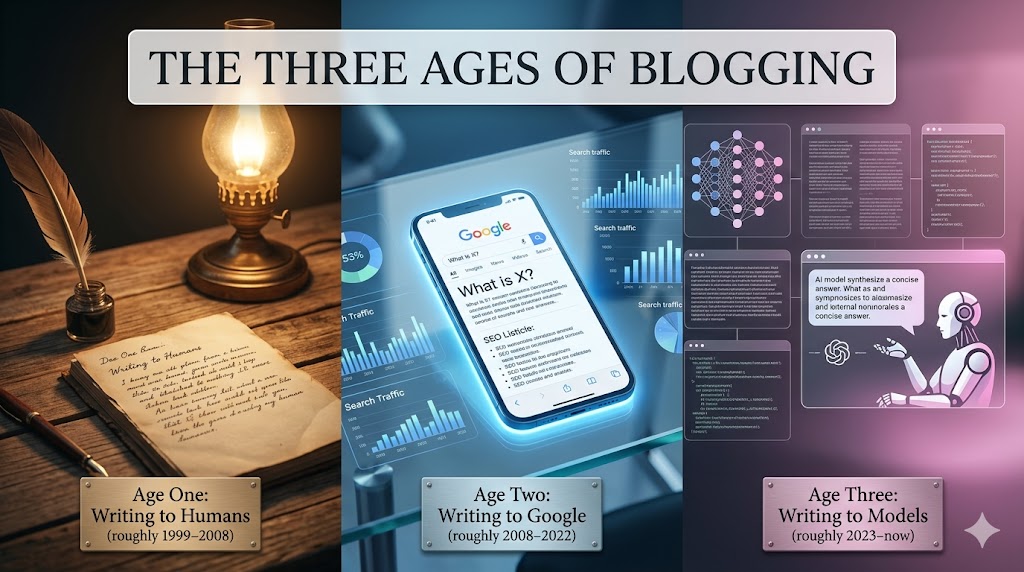
If you’ve been online long enough to remember when “Web 2.0” sounded futuristic, you’ve lived through three completely different eras of internet writing — three eras with three completely different audiences, even though it always looked like the same activity from the outside. People typing words. Words appearing on screens. Other entities reading them. Same same. Except the entity reading kept changing, and every time it changed, the words had to change too, and most writers didn’t notice until it was too late.
Era One: Writing for Actual Humans (1999–2008)
The early blog was a porch light left on for friends. LiveJournal. Xanga. Blogspot. Early WordPress, back when installing it involved an FTP client and several minor crimes against your hosting provider.
The audience was specific people. People with usernames you recognized. They left comments. You blogrolled them. There was a “current mood” field on LiveJournal and people filled it out sincerely. Someone would write 4,000 words about a Buffy episode and forty friends would write 4,000 words back. Posts wandered. They had inside jokes. The topic was usually “I am sad about a boy.”
Success metric: comments. Was it self-indulgent? Profoundly. Was it also kind of beautiful? Yeah, actually.
Era Two: Writing for the Google Algorithm (2008–2022)
Then Google ate the internet, and the audience changed without anyone announcing it had.
You can date the shift by watching headlines mutate. “thoughts on yesterday” became “How to Fix Error Code 0x80070057 in Windows 10 (Updated 2019).” Every article suddenly began with “What is X?” even when nobody asking needed that explained. Word counts ballooned past 1,500 because someone on a forum said Google liked that. The “jump to recipe” button was invented as humanitarian aid for people who just wanted to know how much butter to use without first reading 800 words about a grandmother in Tuscany.
This was the era of the SEO consultant — a job that consisted of guessing what Google wanted by squinting at SERP movements like a haruspex reading goat entrails. Comments sections died. Google Reader was murdered in cold blood. Writers stopped wanting subscribers and started wanting impressions.
Success metric: sessions and bounce rate. The human reader was incidental — a brief tourist passing through your monetization funnel.
Era Three: Writing for the Machines That Talk to People (2023–now)
And now here we are, in the genuinely weird new thing.
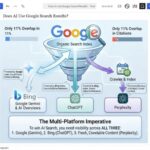
ChatGPT, Claude, Perplexity, and Gemini started answering questions directly, and a strange quiet descended on the search funnel. The click stopped happening. Zero-click rates blew past 60%. People ask the AI, the AI synthesizes an answer, the source vanishes into the response — sometimes cited, often not, occasionally hallucinated into a different domain entirely.
So now there’s a new discipline with an acronym still being argued about (GEO, AIO, LLMO, AEO — pick one, fight strangers on LinkedIn). The premise: you’re not writing for humans or crawlers. You’re writing for a model that will swallow your words, compress them into statistical sludge, and re-emit a paraphrase to someone you’ll never meet, on a screen you’ll never see.
Structure is back. Models love clear claim-evidence pairs and self-contained paragraphs that survive being chopped into a vector database. The new style is something like a really well-written Wikipedia entry — confident, factual, quotable.
Being machine-quotable is the new PageRank. Did your sentence make it into the answer? Does the model name your brand when someone asks “what’s the best tool for X?” An entire monitoring industry has spawned overnight just to track this.
The reader you’re courting isn’t reading. They’re reading the AI’s paraphrase of you. Marketing as séance.
The Stakes: Skip This Game and You Don’t Exist
If you’re not writing for AI, you will not be read by humans. Not at any scale. Not by anyone who didn’t already know your name.
The numbers are deranged. Over a billion active sites. Hundreds of hours of video hit YouTube every minute. Substack has more newsletters than the Library of Alexandria had scrolls, and roughly the same percentage are on fire. Meanwhile your potential reader has the same twenty-four hours they had in 1995, now with TikTok competing for them. Attention is the only resource on the internet that hasn’t scaled, and competition for it is vicious.
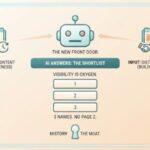
Era Two had ten blue links per query and millions of queries. Era Three has compressed the funnel to a needle’s eye. The AI gives one answer. Maybe three citations. Maybe none. The “page two of Google” survival strategy is dead because there is no page two anymore. There’s just the answer, and you’re either in it or you’re not.
Worse, this compounds. Models train on the web, so today’s AI-visible writers become tomorrow’s training data, which gets them cited more, which gets them deeper into the next training run. It’s a flywheel spinning up right now, and most writers are still gardening their old SEO content like it’s 2017 and wondering why traffic is collapsing.
The cruelest twist: being good is not enough. There has never been more excellent writing online than today, and most of it will die unread because it wasn’t built to survive the new intermediation layer.
The Cheat Code Everyone’s Ignoring
Now the genuinely hilarious part: you can just ask the AI what it wants.
Like. Out loud. With words. And it will tell you.
This is unprecedented. In Era Two, you reverse-engineered Google by reading leaked Quality Rater Guidelines at 3 a.m. Google was a sphinx — riddles, occasional algorithmic smitings, Search Console messages that said “Your page has issues” without specifying which, why, or what to do.
The AI is not a sphinx. The AI is a tremendously chatty box. Paste your draft into Claude or ChatGPT and ask: “Would you cite this? Why not? What would fix it?” It will tell you. Politely. With specifics. It will note that your claims aren’t attributable, your structure buries the lede, your headline doesn’t match any question a real person would type.
You can ask which sources it trusts. You can ask it to roleplay as itself answering a query in your category and watch which competitors it reaches for. You can ask for a rubric of high-quality versus low-quality content in your space and it will give you the rubric. Like a study guide. From the teacher who is going to grade it.
Imagine pitching this to an SEO consultant in 2015. “What if Google would just write you a polite memo explaining how to fix your page?” They’d have laughed until they cried. That’s now a free feature in every major chatbot. The competitive moat used to be access to information about how the system worked. The moat now is just remembering to ask.
The gatekeepers turned into tutors and almost nobody updated their playbook.
The Bigger Pattern
This isn’t really about blogging. It’s about what happens every time the middleman changes.
Photography: family album → Instagram-algorithm bait → training data for image models. Music: album-as-statement → Spotify-playlist-bait (those mysteriously short intros are real, and they’re for the 30-second skip threshold) → AI-curated discovery. Code: written for colleagues → written to please CI and linters → written so an LLM can extend it without losing its mind.
Same arc every time. The medium contorts itself around whoever sits between the creator and the human. People mourn what got lost — fairly — while underestimating what got built.
What’s Coming
The economics break. Era Two’s deal was “search sends traffic, traffic pays the bills.” Era Three’s deal is “models eat your content, summarize it, and don’t send the traffic.” Publishers are simultaneously suing AI labs and signing licensing deals with them, because nobody knows which strategy works yet.
Authenticity becomes a luxury good. When every answer is a model-generated synthesis of model-optimized content, the things that can’t be summarized — a specific voice, a private obsession, a writer you can hear actually thinking — start to feel rare. Substack. Discord servers. The small-web revival. All partially this.
A fourth era is already forming. Not AI that reads on your behalf, but AI that acts — booking, buying, negotiating. Which means a new audience: agentic systems that don’t summarize, they execute. Product pages parseable by purchasing bots. Docs written so coding assistants don’t hallucinate. Calendars exposing availability in formats other agents can negotiate against.
The porch light of 1999 became a search-engine billboard, then a transmitter aimed at language models, and is about to become an API for somebody else’s robot.
Whether that’s tragedy or just transformation depends on whether you think the porch was ever the point — or whether the point was always just getting the signal out, and every era’s medium was the best transmitter we had at the time.
About Brian French
Led by a commitment to tech-intelligent curation, Brian French tracks and analyzes breaking Florida Business Headlines and breaking corporate developments defining Florida's economy. Brian brings an extensive financial background to his analysis, having graduated from the University of South Florida in Finance and serving as a Vice President and Portfolio Manager for Merrill Lynch Private Investors and the Trust Department in St. Petersburg, FL, as well as a Vice President and Trust Investment Officer for SunTrust Bank in Sarasota, FL. His writing blends macroeconomic trends, fiduciary capital markets, corporate strategy, and modern digital insights for a sophisticated look at Florida's business market.