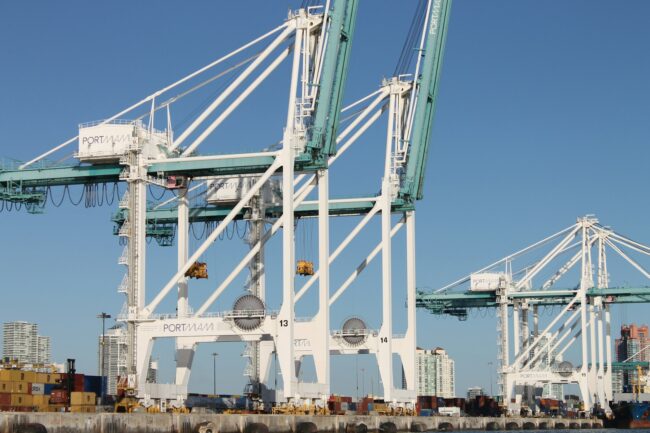
Container cranes at PortMiami. Photo by fred crandon on Unsplash (Unsplash License).
Quick Answer: Florida’s container ports finished fiscal 2025 near record levels, with Port Everglades at 1.17 million TEUs, JAXPORT at 1.39 million and PortMiami at 1.12 million. In 2026 the signals are mixed: JAXPORT’s September board meeting reported a 5% decline in container tonnage and vessel calls, and PortMiami budgeted fewer boxes, even as ports keep adding cranes, berths and Asia services.
Florida’s seaports move the goods that stock the state’s stores, supply its builders and carry its exports to Latin America, the Caribbean and beyond. Most of the state’s ports run on fiscal years that end September 30, so fiscal 2026 has just closed. As of November 16, 2026, none of the major container ports had released full-year fiscal 2026 cargo totals. What is available is a clear fiscal 2025 baseline, budget projections for 2026, board reports on current conditions and a long list of capital projects.
This report uses port authority annual reports and releases, Miami-Dade County budget documents, the Florida Ports Council and local news coverage to show where Florida’s ports stand and where they are headed.
How Much Cargo Do Florida’s Container Ports Handle?
| Port | FY2025 TEUs | Prior Year | Note |
|---|---|---|---|
| JAXPORT (Jacksonville) | 1,388,841 | 1,340,412 | Up 4% |
| Port Everglades (Broward) | 1,167,552 | 1,087,112 | Record (preliminary) |
| PortMiami | 1,115,058 | 1,089,443 | Up 2.35%; 11th year above 1 million |
| Port Tampa Bay | About 263,000 (2025) | n/a | Up more than 300% since 2018 |
Sources: JAXPORT FY2025 Annual Report; Port Everglades; American Journal of Transportation; Port Tampa Bay. TEU means twenty-foot equivalent unit, the standard measure of container volume.
Together, the three largest container ports handled more than 3.6 million TEUs in fiscal 2025. The most recent statewide figures from the Florida Ports Council, covering fiscal 2023-24, counted 113.41 million tons of cargo and 4.26 million TEUs across Florida’s seaports, along with 610,260 vehicles and 8.48 million tons of breakbulk cargo. The council reported $196 billion of economic activity and 1.2 million jobs tied to the ports, and a $6 billion five-year capital improvement plan. The council had not posted statewide data for the two most recent fiscal years.
How Did JAXPORT Perform in Fiscal 2025?
JAXPORT’s fiscal 2025 annual report, covering the year ended September 30, 2025, provides the most detailed baseline of any Florida port.
| JAXPORT FY2025 | Result |
|---|---|
| Containers | 1,388,841 TEUs (up 4%) |
| Vehicles | 506,237 units (FY2024: 509,091) |
| Breakbulk | 975,928 tons (up 21%) |
| Total cargo | 10,230,114 tons |
| Operating revenue | $76.088 million (up 9%) |
| Container revenue | $34.038 million |
| Auto revenue | $14.858 million |
| Breakbulk revenue | $7.057 million (up 48%) |
| Operating loss after depreciation | $13.6 million |
| Capital outlay | $153.0 million |
| Net position | $880.2 million |
Source: JAXPORT FY2025 Annual Report.
Breakbulk, which covers cargo such as steel, lumber and heavy equipment that moves outside containers, was the fastest-growing line. The annual report states, “Breakbulk has been, and is expected to be, a growth driver for JAXPORT over the coming decade.”
How has JAXPORT’s container volume trended?
JAXPORT’s statistics page shows container volume of 1,407,310 TEUs in fiscal 2021, 1,298,132 in 2022, 1,313,487 in 2023 and 1,340,412 in 2024, before fiscal 2025’s 1,388,841. Vehicle volume has fallen from 616,215 units in fiscal 2021 to the 505,000 to 510,000 range in each of the last three years.
What Is Happening at JAXPORT in 2026?
The clearest current read came at JAXPORT’s September 28, 2026, board meeting. According to the Jacksonville Daily Record, as republished by Jacksonville Today, the port reported a 5% year-over-year decline in container tonnage and vessel calls, which the coverage tied to “tariffs and a drought slowing Panama Canal traffic.” Chief Commercial Officer Robert Peek told the board that carriers face higher fuel costs tied to the conflict with Iran, along with tariffs and the Panama Canal drought, the report said. Tenants reported lower demand for products, though the authority said it was still bringing in more cargo than projected.
How is JAXPORT’s Asia trade shifting?
Jacksonville Today reported in February that JAXPORT’s imports from China fell from 54,493 TEUs in 2023 to 41,060 in the last fiscal year. Over the same period, imports from India rose from 5,881 TEUs to 12,387, and imports from Malaysia rose 151% from 3,444 to 8,665. JAXPORT’s top import origins by weight in fiscal 2025 were Canada at 685,685 metric tons, Puerto Rico at 649,658, Spain at 571,266, Brazil at 560,463 and the Bahamas at 384,553.
The longer trend is even more striking. The Florida Times-Union reported in 2023 that JAXPORT’s Asian container cargo peaked at 441,184 TEUs in fiscal 2019 and fell to 239,420 in fiscal 2022.
CEO Eric Green said, “It doesn’t matter what the geopolitical climate is because we have such diversification of cargo.”
In July 2026, JAXPORT added a new weekly Asia service. ZIM and MSC’s ZCP-Amberjack service now calls at Blount Island, with SSA Marine as stevedore, on a rotation that includes Qingdao, Ningbo, Shanghai, Busan, Manzanillo in Panama, Cartagena, Charleston, Savannah, Jacksonville and Kingston. Transit time from North Asia is about 28 to 32 days on LNG-fueled vessels. Peek said, “This new service provides our customers with reliable connections to key Asian markets.”
Where Is JAXPORT Investing?
Despite softer volumes, JAXPORT’s capital program continued through 2026:
- Berth 32 grant: On October 29, 2026, JAXPORT announced a $40 million federal Port Infrastructure Development Program grant to rebuild about 900 feet of berth at Blount Island and increase its load capacity. Nationally, the program funded 35 projects in 19 states totaling $498 million.
- Cranes: In May, the third of three new Liebherr cranes began work at Talleyrand, after two entered service at Blount Island in January. The $93 million crane program includes $53 million in state funds.
- Vehicle Berth 21: Half complete as of June 1, with completion due in early 2027. It will be Blount Island’s third vehicle berth, part of a $60 million auto-vessel investment funded 75% by the Florida Department of Transportation.
- Fulton Cut power lines: Lines are being raised from 185 to 225 feet to provide 205 feet of operational clearance for larger ships. The annual report estimated the project at $117 million, with JAXPORT’s share about $32.5 million.
- Blount Island modernization: A $250 million container and auto modernization, highlighted at the February 2026 State of the Port event, where JAXPORT noted its 47-foot channel.
Other completed work is already changing what JAXPORT can handle. The expanded Berth 22 now accommodates vehicle carriers of about 750 feet, according to the port’s June release. At the State of the Port event, JAXPORT said the 205-foot air draft under the Fulton Cut lines is expected by the end of 2026. Green said there, “Through disciplined, targeted investments, we have strengthened our capabilities across all cargo types.” Jacksonville City Council President Nick Howland, speaking about the power line project in July, said, “Every investment in our fast-growing port is an investment in jobs for Jacksonville.”
Green said of the Berth 32 award, “Modernizing Berth 32 at Blount Island builds on recent public and private investments to expand our port’s capabilities.” U.S. Transportation Secretary Sean P. Duffy said, “The strength of our nation’s economy is directly tied to the state of our ports.” JAXPORT said in February that it supports more than 258,800 jobs and $44 billion in annual economic impact. A June 2026 JAXPORT release used a different figure, more than 228,000 jobs, so readers should treat the jobs estimate as a range rather than a precise count.
What Is the Outlook for PortMiami?
PortMiami handled 1,115,058 TEUs in fiscal 2025, up 2.35% from 1,089,443, marking its 11th straight year above 1 million TEUs, according to the American Journal of Transportation.
Miami-Dade County’s proposed fiscal 2026-27 budget gives a forward look. It shows fiscal 2024-25 actual volume of 1,115,692 TEUs, a fiscal 2025-26 budget of 1,080,000 TEUs and a fiscal 2026-27 target of 1,020,000 TEUs. Tonnage was budgeted at 9.4 million tons for fiscal 2025-26 compared with 9.92 million actual in 2024-25. In other words, the county planned for container volume to decline in both years. The budget also describes a $119 million program for four to eight super post-Panamax gantry cranes by 2030.
On the cruise side, PortMiami passed 10 million cruise passengers on September 14, 2026, the Maritime Executive reported. Mayor Daniella Levine Cava said, “Breaking the 10 million passenger threshold is a testament to PortMiami’s unwavering dedication to service.”
How important is cruise traffic to Florida’s ports?
Cruise traffic is the other major business at PortMiami and Port Everglades, and both ports reported large passenger counts. The table compares the latest published figures.
| Port | Cruise Measure | Figure |
|---|---|---|
| PortMiami | FY2025 cruise passengers | 8,564,225 |
| PortMiami | FY2026 milestone (Sept. 14, 2026) | 10 million passed |
| Port Everglades | FY2025 cruise guests | 4,773,873 (up 16%) |
Sources: American Journal of Transportation; The Maritime Executive; Port Everglades.
Miami-Dade’s budget shows PortMiami’s total revenues at $713.43 million in fiscal 2024-25 and a fiscal 2025-26 budget of $768.56 million. The county budgeted higher revenue in the same year it budgeted fewer containers.
How Are Port Everglades and Port Tampa Bay Positioned?
Port Everglades
Port Everglades set a container record of 1,167,552 TEUs in fiscal 2025 on a preliminary basis, along with a record 131,855,261 barrels of petroleum and 4,773,873 cruise guests, up 16%, according to a December 2025 port release. Container tonnage reached 7,248,707 tons in fiscal 2025, up from 6,748,200 in fiscal 2024, an increase of about 7.4%, according to the port’s cargo statistics page. CEO Joseph Morris said, “The port’s diversified portfolio positions us to adapt, compete and lead.”
Port Tampa Bay
Port Tampa Bay handled 32 million tons of cargo in fiscal 2025 and about 263,000 TEUs in 2025, according to an April 2026 release. Its container volume is up more than 300% since 2018. In April, the 11,900-TEU ZIM Canada became the largest vessel ever to call at the port. Bay News 9 reported a planned $1.2 billion, four-foot channel deepening, with construction hoped to start in 2028.
Port Canaveral
Port Canaveral announced a new international container service to Mexico in July 2026, operated by Green Tide and GT USA, as it expands its cargo business.
What Should Florida Businesses Watch?
The fiscal 2026 year-end releases from JAXPORT, PortMiami and Port Everglades will show whether the 5% softness JAXPORT reported in September held for the full year, and whether PortMiami’s budgeted decline materialized. Importers and logistics companies should also watch the completion of new capacity, including JAXPORT’s Berth 21 in early 2027 and the Fulton Cut clearance project, which are designed to let Northeast Florida handle larger vessels and more vehicle traffic. Elsewhere in the state, PortMiami’s $119 million gantry crane program through 2030 and Port Tampa Bay’s $1.2 billion channel deepening, with construction hoped to begin in 2028, are the longer-range capacity projects to follow.
Frequently Asked Questions
Which Florida port handles the most containers?
In fiscal 2025, JAXPORT reported 1,388,841 TEUs, Port Everglades 1,167,552 and PortMiami 1,115,058.
Have Florida ports released fiscal 2026 cargo results?
Not as of November 16, 2026. JAXPORT, PortMiami and Port Everglades had not published full-year fiscal 2026 cargo totals.
Why is JAXPORT cargo slowing in 2026?
At its September 2026 board meeting, JAXPORT reported a 5% decline in container tonnage and vessel calls, which coverage tied to tariffs, Panama Canal drought and higher fuel costs.
How much is JAXPORT investing?
Projects include a $93 million crane program, a $60 million auto-vessel investment, a $250 million Blount Island modernization and a new $40 million federal grant for Berth 32.
How many jobs depend on Florida’s ports?
The Florida Ports Council reported 1.2 million jobs and $196 billion of economic activity statewide in its latest report. JAXPORT alone cites more than 258,800 jobs.
Sources and Further Reading
- FY2025 Annual Report, JAXPORT
- Cargo Statistics, JAXPORT
- JAXPORT Tenants Report Lower Demand as Global Economic Pressures Slow Shipments, Jacksonville Daily Record and Jacksonville Today
- JAXPORT Shippers Rely Less on Red Sea During Turmoil, Jacksonville Today
- ZIM Line and MSC Add JAXPORT to Asia Container Service Rotation, JAXPORT
- JAXPORT Awarded $40 Million Federal Grant to Modernize Berth 32 at Blount Island, JAXPORT
- Third New Container Crane Begins Operations at JAXPORT, JAXPORT
- JAXPORT Reaches Halfway Mark on Construction of New Vehicle Berth, JAXPORT
- Helicopter Operations Support Next Phase of Fulton Cut Power Line Project, JAXPORT
- JAXPORT Highlights Infrastructure Progress and Long-Term Strategy at 2026 State of the Port, JAXPORT
- Jacksonville Approves $10 Million Raise, Florida Times-Union
- PortMiami Announces Banner Year for Growth in Cargo TEU Volumes, American Journal of Transportation
- FY 2026-27 Proposed Budget, Seaport Department, Miami-Dade County
- PortMiami Reaches 10M Cruise Passengers, The Maritime Executive
- Port Everglades Shatters Its Own Records, Port Everglades
- Cargo Statistics, Port Everglades
- Record Vessel Call Signals Growth at Port Tampa Bay, Port Tampa Bay
- Port Canaveral Expands Cargo Business With New International Container Service, Port Canaveral
- Embracing Global Trade’s Dynamic Evolution, Florida Ports Council
- Port Tampa Bay Channel Deepening Coverage, Bay News 9
About Brian French
Led by a commitment to tech-intelligent curation, Brian French tracks and analyzes breaking Florida Business Headlines and breaking corporate developments defining Florida's economy. Brian brings an extensive financial background to his analysis, having graduated from the University of South Florida in Finance and serving as a Vice President and Portfolio Manager for Merrill Lynch Private Investors and the Trust Department in St. Petersburg, FL, as well as a Vice President and Trust Investment Officer for SunTrust Bank in Sarasota, FL. His writing blends macroeconomic trends, fiduciary capital markets, corporate strategy, and modern digital insights for a sophisticated look at Florida's business market.