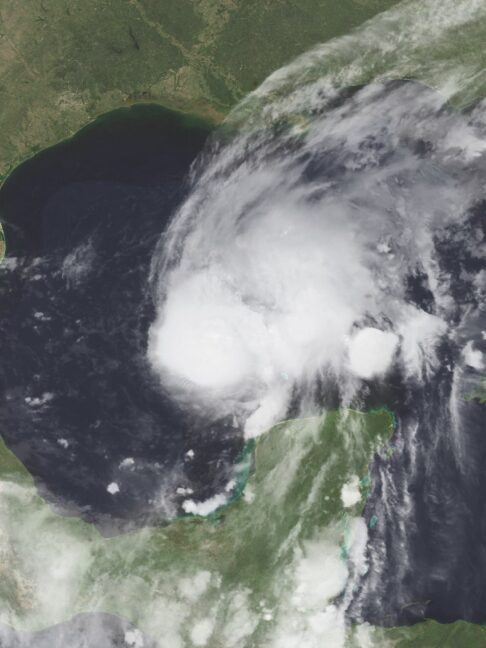
Hurricane Isaias on the night of October 8, 2026. Image: NOAA GOES-19 ABI imagery via Wikimedia Commons. License: Public domain.
Quick Answer: Hurricane Isaias, the only hurricane of the 2026 Atlantic season, made landfall near Destin on October 9 and generated 68,071 insurance claims in Florida with more than $735.5 million in estimated insured losses, according to state data. Industry modelers put total insured losses in the low single-digit billions, and AM Best called the storm primarily an earnings event rather than a capital threat for Florida insurers.
The 2026 Atlantic hurricane season officially ends November 30, but forecasters at AccuWeather declared it over on November 9, about three weeks early. For Florida’s economy, the season will be remembered for two things: how quiet it was overall, and the one storm that broke through. Hurricane Isaias struck the western Panhandle as a Category 2 hurricane and produced the first significant test of Florida’s reshaped property insurance market since 2024.
This report pulls together storm data, Florida Office of Insurance Regulation claims figures as reported by news outlets, catastrophe model estimates, and rating agency analysis to answer the questions Florida business owners, insurers and policyholders are asking as the season closes.
How unusual was the 2026 Atlantic hurricane season?
By AccuWeather’s count, the 2026 season produced 10 named storms, the fewest since 2014, when there were eight. It produced only one hurricane, which AccuWeather said had not happened since 1925. The Atlantic went without a hurricane through September 21, breaking a 112-year record, and Isaias did not become a hurricane until October 8, making it the latest first hurricane of a season in 121 years.
The cause was a rapidly strengthening El Niño that took hold earlier than usual. El Niño increases wind shear over the Atlantic, which tears apart developing storms. Forecasts tracked the shift. AccuWeather’s March outlook called for 11 to 16 named storms; by mid-August it had cut that to 8 to 11 named storms, 3 to 4 hurricanes, and 1 to 2 major hurricanes, then trimmed again in September.
| 2026 season fact | Detail |
|---|---|
| Named storms | 10, fewest since 2014 |
| Hurricanes | 1 (Isaias), first one-hurricane season since 1925 |
| First hurricane formed | October 8, latest in 121 years |
| Last named storm | Subtropical Storm Josephine, October 21 |
| Main suppressing factor | Early, rapidly strengthening El Niño |
| Other U.S. landfalls | Arthur (Texas, June), Bertha (Louisiana, Texas, July), Edouard (Louisiana, about Sept. 1) |
Source: AccuWeather, “Is the 2026 Atlantic hurricane season over?” November 9, 2026.
Where and when did Hurricane Isaias hit Florida?
Isaias made landfall near Destin as a Category 2 hurricane on Friday, October 9, 2026. It had peaked earlier as a Category 3 storm with 120 mph sustained winds, the first major hurricane of the season, before increasing wind shear weakened it. Insurance Business reported it was the first hurricane to strike the continental United States since Milton in 2024.
The worst reported wind damage was in the western Panhandle. In Milton, in Santa Rosa County, roofs were torn off an apartment complex and a high school gym, and in Pensacola a hotel roof was stripped. More than 800,000 customers lost power across Florida, Alabama, Georgia and the Carolinas. Beinsure reported six deaths in Florida linked to the storm, while AccuWeather counted as many as eight from indirect impacts.
Why wasn’t the storm surge worse?
Before landfall, forecasters warned of 6 to 9 feet of surge from the Alabama-Florida border to Grayton Beach. AM Best later noted that the storm’s strongest winds were west of the center, pushing water away from the coast and reducing surge and flood damage. As a result, most insured losses were from wind. Moody’s RMS estimated losses to the National Flood Insurance Program at about $250 million.
How many insurance claims has Isaias generated in Florida?
Claims have climbed steadily since landfall. Beinsure reported on October 25 that about 55,000 claims had been filed with Florida’s Office of Insurance Regulation, tied to nearly $582 million in insured losses. A later Florida Phoenix report, citing OIR data, put the total at 68,071 claims with estimated insured losses of more than $735.5 million.
| OIR claims measure | Count |
|---|---|
| Total claims filed | 68,071 |
| Closed with payment | 25,211 |
| Closed without payment | 14,402 |
| Open, no payment yet | 20,482 |
| Share of claims closed | 58.2% |
| Closed: damage below deductible | 6,835 |
| Closed: administrative (duplicates, errors, withdrawn) | 5,374 |
| Private passenger auto claims | 7,825 |
| Estimated insured losses | More than $735.5 million |
Source: Florida Phoenix, “Hurricane Isaias claims keep climbing,” citing Florida Office of Insurance Regulation data.
More than 81% of claims were residential property. Private passenger auto was the second-largest category. Notably, 6,835 claims were closed because damage fell below the deductible. In Florida, hurricane deductibles are typically a percentage of a home’s dwelling value, which means many homeowners with moderate roof or fence damage absorb the cost themselves.
Which Panhandle counties were hit hardest?
In the OIR breakdown reported by Beinsure as of October 25, Santa Rosa County led with more than 26,000 claims, followed by Escambia with nearly 17,000, Okaloosa with about 5,200, Walton with more than 2,000, and Bay with almost 2,000. Before landfall, analytics firm Cotality estimated that about 353,000 homes in Escambia, Santa Rosa, Okaloosa and Walton counties faced moderate or greater wind risk, with combined reconstruction value of $115.8 billion.
How much will Hurricane Isaias cost insurers?
Estimates vary by scope. Before landfall, reinsurance brokers projected insured losses in the “mid-single-digit billions,” using Hurricane Sally in 2020 as the closest comparison. After landfall, the models came in lower.
| Estimate | Range | Scope |
|---|---|---|
| Moody’s RMS | $2.5B to $4.5B | Multistate insured losses, mostly wind |
| Karen Clark & Company | About $3B | Privately insured losses nationwide, excluding NFIP |
| AM Best | Low single-digit billions | Industry insured losses |
| Moody’s RMS (flood) | About $250M | National Flood Insurance Program |
| Florida OIR (reported) | More than $735.5M | Florida claims filed to date |
| AccuWeather | $16B to $20B | Preliminary total damage and economic loss, not insured |
Sources: Beinsure (October 15 and 25, 2026), Florida Phoenix, Insurance Business, AccuWeather.
The gap between the OIR running total and the model estimates is expected. Model estimates cover multiple states and include losses not yet reported, while OIR’s figure reflects Florida claims as filed and estimated by insurers at a point in time. AccuWeather’s $16 billion to $20 billion figure measures broader economic loss, including uninsured damage and disruption, and should not be compared directly with insured losses.
How does Isaias compare with recent Florida hurricanes?
| Storm | Florida landfall | Insured losses (Florida) | Claims |
|---|---|---|---|
| Isaias | Oct. 2026, near Destin | More than $735.5M (to date) | 68,071 (to date) |
| Milton | Oct. 2024, Siesta Key | About $5.6B | 385,146 |
| Helene | Sept. 2024, Taylor County | About $2.58B | 155,182 |
| Michael | Oct. 2018, Mexico Beach | About $9.1B | Nearly 159,000 |
Sources: Beinsure, citing state insurance data; Florida Phoenix for Isaias totals.
By claim count, Isaias so far is less than one-fifth the size of Milton and well under half of Helene or Michael.
Is Florida’s insurance market strong enough to absorb Isaias?
Rating agency AM Best said on October 15 that it expects Isaias to hit insurers’ earnings more than their capital. It described the storm as “primarily an earnings event,” said it does not expect substantial rate increases or a material reduction in capacity, and expects limited effect on reinsurance pricing and upcoming renewals. Before landfall, reinsurance brokers likewise said the storm was unlikely to materially change January 1 reinsurance renewals given ample reinsurance capital.
AM Best’s data also shows how fragmented Florida’s market is. Florida’s property market wrote about $43.58 billion in direct premiums in 2025. The top 10 property groups held 47.9% of direct premiums written, below the national average of about 54%. More than 70 active insurers write at least half their premiums in Florida, which AM Best flagged as a concentration risk.
| Florida property insurer group (2025) | Share of direct premiums |
|---|---|
| State Farm | 7.3% |
| Progressive | 7.0% |
| Berkshire Hathaway | 6.7% |
| Citizens Property Insurance | 5.9% |
| Top 10 groups combined | 47.9% |
Source: AM Best data as reported by Beinsure, October 15, 2026.
Where does Citizens Property Insurance stand?
Florida’s state-backed insurer of last resort entered the season far smaller than in recent years. In a June 23, 2026 release, Citizens said its policy count had fallen from 1.4 million in late 2023 to about 274,000, roughly 2% of the Florida residential market. It said 20 new companies have entered the state since 2022.
Citizens reported at least $9.6 billion of claims-paying ability for 2026, made up of $5.34 billion of surplus, $1.44 billion from the Florida Hurricane Catastrophe Fund, and $2.82 billion of private reinsurance. It said that structure could pay claims from a 1-in-360-year hurricane without assessments on Florida consumers, and that reinsurance rates had fallen nearly 30% over the prior year. AM Best called continued depopulation of Citizens a positive and said the mild 2026 season should help preserve its financial position.
What does the 2026 season mean for Florida businesses?
For most of Florida, the 2026 season was a reprieve. A single hurricane, a weakening storm at landfall and a surge that underperformed forecasts kept losses well below the 2024 storms. For the western Panhandle, the impact is concentrated and real: tens of thousands of claims in Santa Rosa and Escambia counties, power outages, and roof damage to housing and commercial buildings. Gov. Ron DeSantis requested about $237 million in federal resources for a major disaster declaration covering public assistance for 15 counties and individual assistance for eight, according to Beinsure.
Three practical points follow from the data. Businesses with open claims should watch closure timelines, since more than 20,000 claims remained open without payment in the latest OIR figures cited. Property owners renewing policies should review percentage-based hurricane deductibles, which closed thousands of claims without payment. And companies budgeting for 2027 insurance costs have rating agency and broker commentary suggesting Isaias alone should not drive a broad repricing.
Brian’s Take
As a former investment analyst, what stands out to me here is not the storm, it’s the plumbing. Florida’s insurance market took a direct hit from a Category 2 hurricane and the people who price risk for a living called it an earnings event. Citizens is down to roughly 274,000 policies with $9.6 billion of claims-paying ability, and reinsurance rates were falling nearly 30% before the season started. That is a very different market from the one Florida had a few years ago.
But I’d caution against reading one quiet season as proof the problem is solved. The 2026 season was quiet because of El Niño, not because Florida got less exposed. More than 70 insurers still write at least half their business in this state, and 6,835 Isaias claims closed because damage fell below the deductible. That’s risk moving from insurers back onto homeowners and small businesses, and Panhandle owners are feeling it right now.
For Florida business owners, my read is simple: the data supports cautious optimism on 2027 insurance pricing, but your deductible is your real exposure. Know the number before the next storm does.
Frequently Asked Questions
Is the 2026 Atlantic hurricane season over?
The season officially ends November 30, 2026. AccuWeather declared it effectively over on November 9 because El Niño-driven wind shear was suppressing storm development.
Where did Hurricane Isaias make landfall?
Isaias made landfall near Destin, Florida, as a Category 2 hurricane on October 9, 2026, after peaking as a Category 3 storm with 120 mph winds.
How many insurance claims did Hurricane Isaias cause in Florida?
The latest Florida Office of Insurance Regulation figures cited by Florida Phoenix show 68,071 claims and more than $735.5 million in estimated insured losses, with 58.2% of claims closed.
What are total insured losses from Hurricane Isaias?
Moody’s RMS estimated $2.5 billion to $4.5 billion in multistate insured losses, and Karen Clark & Company estimated about $3 billion in privately insured losses, excluding flood insurance.
Will Hurricane Isaias raise Florida insurance rates?
AM Best said it does not expect substantial rate increases or material capacity reductions from Isaias, and called the storm primarily an earnings event for insurers.
How big is Citizens Property Insurance now?
Citizens reported about 274,000 policies in June 2026, roughly 2% of Florida’s residential market, down from 1.4 million in late 2023.
Sources and Further Reading
- Is the 2026 Atlantic Hurricane Season Over? El Niño Suppressing Late-Season Storm Risk, AccuWeather
- Isaias Claims Begin as Panhandle Counts Damage From First US Hurricane Since 2024, Insurance Business
- Hurricane Isaias Generated More Than 55K Insurance Claims in Florida, Beinsure
- Hurricane Isaias Claims Keep Climbing, Florida Phoenix
- Hurricane Isaias Losses Unlikely to Weaken Florida Insurers’ Capital, Beinsure
- Smaller Citizens Secures Coverage for 2026 Hurricane Season, Citizens Property Insurance Corporation
About Brian French
Led by a commitment to tech-intelligent curation, Brian French tracks and analyzes breaking Florida Business Headlines and breaking corporate developments defining Florida's economy. Brian brings an extensive financial background to his analysis, having graduated from the University of South Florida in Finance and serving as a Vice President and Portfolio Manager for Merrill Lynch Private Investors and the Trust Department in St. Petersburg, FL, as well as a Vice President and Trust Investment Officer for SunTrust Bank in Sarasota, FL. His writing blends macroeconomic trends, fiduciary capital markets, corporate strategy, and modern digital insights for a sophisticated look at Florida's business market.