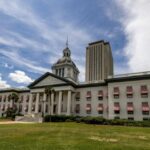
Photo: Ana Lourenço via Unsplash (Unsplash License)
Quick Answer: The National Retail Federation expects U.S. holiday retail sales to grow 4.2% to about $1.013 trillion in November and December 2026, with 325,000 to 375,000 seasonal hires. Florida retailers are heading into Black Friday on November 27 with sales tax collections running ahead of state estimates, but shoppers say their current finances are getting tighter.
Florida retailers are about to find out whether a strong national forecast reaches their own cash registers. The National Retail Federation (NRF) forecasts that 2026 holiday sales will pass the trillion-dollar mark. The Florida Retail Federation (FRF) is again asking shoppers to “Find It in Florida,” steering spending toward stores that employ Floridians and collect the state’s sales tax.
The Florida data is mixed. Sales tax receipts, the state’s best real-time read on consumer spending, have been coming in above forecast. The statewide unemployment rate has dropped from 4.8% in May to 4.3% in October. But consumer surveys show Floridians feel worse about their present finances even as they grow more hopeful about next year. Here is what the numbers say as the season starts.
What is the NRF forecasting for the 2026 holiday season?
On October 15, 2026, the NRF projected that retail sales from November 1 through December 31 will grow 4.2% over 2025, for a total of about $1.013 trillion. Holiday sales in 2025 rose 3.1% from 2024 to $972 billion, so the 2026 forecast means roughly $41 billion more spending than last year. Florida Trend, citing the forecast, noted that 4.2% would be the fastest holiday growth since 2021 if it holds.
The NRF builds the forecast with an economic model that uses consumer spending, disposable personal income, employment, wages, inflation and prior monthly retail sales. The figure excludes automobile dealers, gasoline stations and restaurants. In practice it measures general merchandise, apparel, electronics, groceries, online sales and similar categories, not the restaurant and fuel spending that matters so much to Florida’s tourism economy.
NRF President and CEO Matthew Shay said consumers will “prioritize the holiday season even as they remain mindful of their budgets.” NRF Chief Economist Mark Mathews called consumers the “bright spot in the economy.” He also said inflation, rising gas prices and pressure on household budgets will hit income groups differently.
How much of the growth is real, and how much is inflation?
This matters for retailers planning inventory and staffing. Retail Dive reported that, according to the NRF, nearly half of the forecast nominal growth should come from real consumer spending. The rest reflects higher prices. Mathews said higher diesel prices and higher memory-chip prices are pushing up costs in gift categories such as electronics. He also said he expects goods prices to rise more slowly than headline inflation, because retailers are responding to price-conscious shoppers.
The NRF’s release names persistent inflation, higher gas prices, higher interest rates and elevated consumer debt as the main pressures on households. It does not single out tariffs as a separate factor in this year’s forecast. The cost pressures Mathews described, fuel for freight and component prices for electronics, are the ones most likely to show up on Florida shelf tags.
Did the NRF get last year right?
Not entirely. Retail Dive noted that the 2025 season’s 3.1% growth fell short of the NRF’s forecast range of 3.7% to 4.2%. Florida retailers should treat the 2026 number as a reasonable midpoint, not a guarantee.
| Measure | 2024 | 2025 | 2026 forecast |
|---|---|---|---|
| Holiday sales (Nov. 1 to Dec. 31) | n/a | $972 billion | About $1.013 trillion |
| Year-over-year growth | n/a | 3.1% (forecast was 3.7% to 4.2%) | 4.2% |
| Seasonal retail hiring | 442,000 | About 356,000 (estimated) | 325,000 to 375,000 |
Sources: National Retail Federation; Retail Dive. Excludes auto dealers, gas stations and restaurants.
How many seasonal workers will retailers hire?
The NRF expects retailers to hire 325,000 to 375,000 seasonal workers nationally, compared with an estimated 356,000 last year. That is well below the 442,000 seasonal retail employees hired in 2024, according to Retail Dive. Mathews described the labor market as a “low hire, low fire environment,” and the NRF says retailers are taking a measured approach to hiring.
For Florida employers, a measured national hiring season means less competition for part-time holiday workers than in the tight labor years. The state labor market has also loosened a bit since spring. Data from the U.S. Bureau of Labor Statistics shows Florida’s seasonally adjusted unemployment rate fell from 4.8% in May to a preliminary 4.3% in October 2026. Total nonfarm employment rose from about 10.02 million to about 10.04 million jobs over the same period.
What do Florida’s retail-related jobs numbers show?
The BLS does not publish a stand-alone retail series in its Florida summary. Its closest measure, trade, transportation and utilities, stood at about 1,994,900 jobs in October (preliminary), up from 1,986,900 in May. Leisure and hospitality, the sector that runs alongside retail in Florida’s tourist corridors, held at about 1,343,000 jobs. Both sectors are steady rather than surging, which matches the NRF’s description of employers hiring cautiously.
| Measure | May | Aug | Oct (prelim.) |
|---|---|---|---|
| Unemployment rate | 4.8% | 4.5% | 4.3% |
| Total nonfarm jobs | 10,022,200 | 10,040,100 | 10,043,200 |
| Trade, transportation and utilities | 1,986,900 | 1,985,400 | 1,994,900 |
| Leisure and hospitality | 1,336,600 | 1,340,200 | 1,343,000 |
Source: U.S. Bureau of Labor Statistics, Economy at a Glance: Florida.
What does Florida sales tax data say about consumer spending?
Florida has no personal income tax, so sales tax collections are the most direct state-level signal of what consumers are buying. The latest monthly revenue report from the Legislature’s Office of Economic and Demographic Research (EDR) covers July 2026 collections, which mostly reflect spending that took place in June.
Sales tax collections that month were $3,206.9 million, compared with an estimate of $3,040.1 million. That is $166.8 million, or about 5.5%, above forecast. Collections were 4.0% higher than the $3,083.6 million collected a year earlier. Year-over-year growth of 4.0% is close to the NRF’s 4.2% national holiday forecast, though the two measure different things.
Which spending categories are strong, and which are weak?
The detail in the EDR report matters for retailers. Consumer nondurables, the category closest to everyday retail, posted the largest gain: $117.6 million, or 10.6%, above estimate. Tourism-related collections came in $12.1 million (1.6%) above estimate, and business-related collections $11.5 million (2.2%) above.
Big-ticket categories lagged. Automobiles came in $13.8 million (2.3%) below estimate, other durables $14.8 million (8.5%) below, and building-related collections $18.4 million (8.2%) below. The pattern points to a consumer still buying everyday goods but putting off large purchases. Retailers selling furniture, appliances and home improvement items may face a harder holiday season than those selling apparel, toys, beauty and consumables.
Total net general revenue for July came in $16.3 million (0.4%) below estimate. The EDR traced that shortfall to refunds, which ran $272.6 million above estimate, mainly from Insurance Premium Tax refunds. It was not caused by weak retail activity. The same report cited a 3.4% 12-month increase in the Consumer Price Index and a personal saving rate that rose to 3.0% in July from 2.6% in June.
| Category | Over/(under) estimate | Percent |
|---|---|---|
| Total sales tax ($3,206.9M actual) | +$166.8M | about +5.5% |
| Consumer nondurables | +$117.6M | +10.6% |
| Tourism | +$12.1M | +1.6% |
| Business | +$11.5M | +2.2% |
| Automobiles | ($13.8M) | -2.3% |
| Other durables | ($14.8M) | -8.5% |
| Building | ($18.4M) | -8.2% |
Source: Florida Office of Economic and Demographic Research, Monthly Revenue Report, July 2026. Percent for total sales tax calculated from reported figures.
What is the Florida Retail Federation asking shoppers to do?
The FRF’s answer to the national forecast is its long-running “Find It in Florida” campaign. The FRF describes it as a grassroots effort to get consumers to shop at local Florida retailers, on the argument that those dollars support local businesses, jobs and community economies. According to Florida Trend’s summary of a Florida Politics report, the federation hopes the NRF’s national optimism will carry over to Florida stores this year.
The campaign asks shoppers to buy from Florida retailers and to share their purchases on social media using #FindItInFlorida. Participating businesses can display the campaign logo on storefronts or vehicles. The FRF makes its economic case with its own figures. It says Florida retailers provide one out of every five jobs in the state, generate $104 billion in annual economic impact, pay more than $69 billion in wages each year, and collect and remit more than $20 billion in sales taxes that fund schools, roads and infrastructure.
| Item | Figure |
|---|---|
| Share of Florida jobs | 1 in 5 |
| Annual economic impact | $104 billion |
| Annual wages paid | More than $69 billion |
| Sales taxes collected and remitted | More than $20 billion |
| Shop-local campaign | Find It in Florida (#FindItInFlorida) |
When are Black Friday and Small Business Saturday in 2026?
Thanksgiving falls on Thursday, November 26, 2026. Black Friday is November 27, Small Business Saturday is November 28, and Cyber Monday is November 30. Because Thanksgiving is one day earlier than in 2025, when it fell on November 27, retailers get one extra day between Thanksgiving and Christmas this year. Small Business Saturday is the natural focal point for a shop-local message like the FRF’s, since it gives independent Florida stores a dedicated day after the big-box Black Friday rush.
How do Florida consumers feel heading into the holidays?
Consumer sentiment is one signal among several, and it points in two directions. The University of Florida’s Bureau of Economic and Business Research reported that Florida consumer sentiment rose 0.7 points to 69.1 in October 2026, from a revised 68.4 in September. It was the second straight monthly gain.
The gains came entirely from expectations about the future. The two readings on current conditions fell. The measure of whether personal finances are better than a year ago dropped to 61.8, its seventh straight monthly decline, and the measure of whether now is a good time to buy major household items slipped to 58.5. Hector H. Sandoval, director of UF’s Economic Analysis Program, said the improvement in expectations “contrasts with their increasingly pessimistic assessments of current conditions.” Residents earning under $50,000 a year reported weaker expectations than others.
For retailers, that matches the sales tax data. Floridians are still buying, but they feel squeezed now and are wary of large purchases. It also fits Mathews’ warning that high gas prices would weigh most on lower-income households, and it leaves retailers selling everyday, lower-ticket goods better placed than those selling big-ticket items.
Brian’s Take
When I read a forecast like this one, the headline number is the least useful part. A trillion dollars sounds big, but the NRF itself says nearly half of the 4.2% growth is inflation. And it missed on the high side last year, forecasting 3.7% to 4.2% before the season delivered 3.1%. I’d treat the national figure as a ceiling to plan against, not a promise.
The Florida numbers are more useful. Sales tax collections running $166.8 million above estimate, with consumer nondurables up 10.6% over forecast, tell me Floridians are still spending on everyday things. Weakness in durables and building-related categories, plus a seventh straight monthly drop in how people rate their finances against a year ago, tells me they are cautious about large purchases. That split is the most important fact for a Florida retailer setting holiday inventory and pricing.
The FRF’s Find It in Florida push makes sense on its own terms. Money spent at a Florida store pays Florida wages and funds Florida roads and schools through the sales tax. But a slogan won’t beat a better price. The local merchants who do well this season will be the ones who stay sharp on price and give shoppers something online sellers can’t, and Small Business Saturday is the day to show it.
Frequently Asked Questions
How much will Americans spend this holiday season?
The NRF forecasts holiday retail sales of about $1.013 trillion from November 1 through December 31, 2026, up 4.2% from $972 billion in 2025. The figure excludes auto dealers, gas stations and restaurants.
When is Black Friday 2026?
Black Friday is Friday, November 27, 2026. Small Business Saturday follows on November 28, and Cyber Monday is November 30.
How many seasonal workers will retailers hire in 2026?
The NRF expects 325,000 to 375,000 seasonal hires nationally, compared with an estimated 356,000 in 2025 and 442,000 in 2024.
What is Find It in Florida?
Find It in Florida is a Florida Retail Federation campaign that encourages consumers to shop at Florida retailers to support local businesses, jobs and the sales tax base that funds state services.
Are Florida sales tax collections up in 2026?
Yes. July 2026 sales tax collections, reflecting mostly June activity, were $3,206.9 million. That is 4.0% more than a year earlier and $166.8 million above the state’s estimate.
Is Florida consumer sentiment rising?
Slightly. UF’s index rose to 69.1 in October 2026, driven by better expectations for the future, while views of current personal finances fell for a seventh straight month.
Sources and Further Reading
- NRF Forecasts 2026 Holiday Sales Growth as Consumers Remain Resilient, National Retail Federation
- Coverage of the NRF 2026 holiday sales and seasonal hiring forecast, Retail Dive
- Monday’s Daily Pulse, November 16, 2026, Florida Trend
- Find It in Florida, Florida Retail Federation
- Monthly Revenue Report, July 2026, Florida Office of Economic and Demographic Research
- Economy at a Glance: Florida, U.S. Bureau of Labor Statistics
- October 2026 Florida consumer sentiment report, Florida Realtors (reporting University of Florida Bureau of Economic and Business Research data)
About Brian French
Led by a commitment to tech-intelligent curation, Brian French tracks and analyzes breaking Florida Business Headlines and breaking corporate developments defining Florida's economy. Brian brings an extensive financial background to his analysis, having graduated from the University of South Florida in Finance and serving as a Vice President and Portfolio Manager for Merrill Lynch Private Investors and the Trust Department in St. Petersburg, FL, as well as a Vice President and Trust Investment Officer for SunTrust Bank in Sarasota, FL. His writing blends macroeconomic trends, fiduciary capital markets, corporate strategy, and modern digital insights for a sophisticated look at Florida's business market.