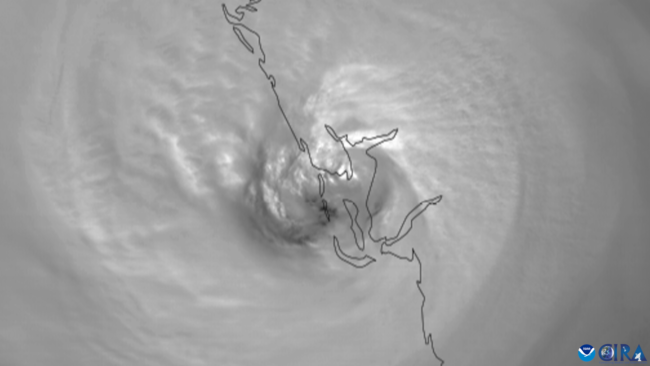
Hurricane Ian at landfall near Cayo Costa, Florida, September 28, 2022. GOES imagery: CSU/CIRA and NOAA, via Wikimedia Commons (public domain).
Quick Answer: Citizens Property Insurance Corporation, Florida’s state-backed insurer of last resort, had about 255,000 policies in mid-September 2026, down from a peak of 1.42 million in October 2023, and expects to end the year near 248,000. Private insurers absorbed hundreds of thousands of policies through depopulation, total insured value fell to about $70 billion from $552 billion three years earlier, and Citizens cut personal-lines rates for 2026 for the first time since 2015.
Three years ago, Citizens Property Insurance Corporation was the largest property insurer in Florida and a symbol of a broken market. Today it insures a fraction of the homes it once did. The shrinkage is the clearest measurable result of Florida’s 2022 and 2023 insurance reforms and of the return of private capital to the state’s homeowners market. This report compiles Citizens’ own releases and published reporting from 2025 and 2026 to show how far the state insurer has fallen, what it now costs to protect it, and what the change means for Florida homeowners and businesses.
How many policies does Citizens Property Insurance have in 2026?
Citizens’ policy count has dropped month after month in 2026. Insurance Journal reported 293,772 policies at the end of May 2026. Citizens said it had approximately 274,000 policies in late June. The News Service of Florida, in a report published by Florida Trend, said Citizens posted 266,231 policies as of August 31, less than half the level of a year earlier, and quoted President and CEO Tim Cerio saying the count was almost at 255,000 as of September 18. Cerio projected about 248,000 policies at the end of 2026.
| Date | Citizens policies | Source |
|---|---|---|
| October 2023 (peak) | 1.42 million | Citizens |
| September 19, 2025 | 768,926 | Artemis |
| End of May 2026 | 293,772 | Insurance Journal |
| Late June 2026 | ~274,000 | Citizens |
| August 31, 2026 | 266,231 | News Service of Florida |
| September 18, 2026 | ~255,000 | News Service of Florida |
| Year-end 2026 (projected) | ~248,000 | News Service of Florida |
Figures as reported by each source on the dates shown. Some outlets describe the 2023 peak as about 1.4 million in September 2023.
How much has Citizens’ exposure fallen?
Even faster than the policy count suggests. Total insured value was about $70 billion as of September 18, 2026, according to the News Service of Florida, compared with potential exposure of $552 billion three years earlier. Cerio projected about $77 billion at year-end. Citizens’ share of the residential market fell to 2% for the first time in more than 15 years, Insurance Journal reported in June, and the News Service of Florida put it at 1.8% in September. Citizens’ share peaked at 23% in 2011.
How has Citizens’ market share changed?
| Period | Citizens share of Florida residential market | Source |
|---|---|---|
| 2011 (peak) | 23% | Insurance Journal |
| Fourth quarter 2023 | 15% | Artemis |
| Second quarter 2025 | 7% | Artemis |
| June 2026 | 2% | Insurance Journal |
| September 2026 | 1.8% | News Service of Florida |
Market share as reported by each outlet; methodologies may differ.
Has depopulation run faster than Citizens expected?
By a wide margin. In September 2025, Artemis reported that Citizens projected ending 2025 with just under 635,000 policies, within a modeled range of 575,434 to 702,545. By December 2025, Citizens said it expected the count to fall to 385,000 by year-end. By the end of May 2026, the count was 293,772, and by mid-September it was near 255,000. Each new projection has been overtaken within months, which shows how quickly private carriers have been willing to take on Florida risk once litigation costs fell.
Why is Citizens shrinking so fast?
Two forces are working together: policies leaving through depopulation, and very few new policies coming in.
How does Citizens depopulation work?
Under its Depopulation Program, Citizens allows approved private insurers to offer coverage to Citizens policyholders, a process often called a takeout. Citizens said more than 546,000 policies were transferred to private insurers through the program in 2025. Artemis reported that about 478,000 policies were taken out in 2024, the highest annual figure on record at the time. Florida also uses a clearinghouse that checks for comparable private offers before a policy can stay in Citizens.
| Year | Policies removed through depopulation | Source |
|---|---|---|
| 2024 | About 478,000 | Artemis |
| 2025 | More than 546,000 | Citizens |
Takeouts move policies to private carriers; some policyholders also leave Citizens on their own.
In September 2026, Insurance Business reported that about 45,000 Citizens policyholders had received non-renewal notices, citing ABC affiliate WBBH, and that affected customers have roughly a year to find replacement coverage. Citizens spokesperson Michael Peltier told the publication he viewed it as the latest indication that the market is getting healthier. Cerio’s advice to those policyholders, as reported by the News Service of Florida, was that “they will find a home in the private market, but they should shop it.”
How few new policies is Citizens writing?
Insurance Journal reported that Citizens wrote 571,375 new personal-lines structures in 2022, compared with 31,871 so far in 2026 as of June. On the commercial side, Citizens wrote almost 35,000 new buildings in 2023 and 131 in 2026. The 2026 Legislature also passed SB 1028, which the News Service of Florida said creates a commercial clearinghouse and allows strong-rated surplus lines insurers to take Citizens commercial policies.
Did Citizens cut rates for 2026?
Yes. On December 10, 2025, the Citizens Board of Governors approved rate recommendations that produce a statewide average decrease of 2.6% for personal-lines policies, the first statewide average decrease since 2015. Citizens said three of every five policyholders would see an average reduction of 11.5%, or $359. The changes take effect June 1, 2026, subject to an order from the Florida Office of Insurance Regulation.
The broader market is moving the same way. The News Service of Florida reported that Insurance Commissioner Mike Yaworsky said 48 companies had filed rate decreases since January 2024, with requested changes ranging from a 0.3% to a 19.7% reduction. Insurance Business, citing the Office of Insurance Regulation, put the statewide average homeowner premium at $3,815 based on April data, and cited the Insurance Information Institute finding that average premiums fell in 51 of Florida’s 67 counties in the first half of 2026.
How much does Citizens pay to protect itself from hurricanes?
Much less than before, because it has much less to protect. For the 2026 hurricane season, Citizens secured $2.82 billion of risk transfer, combining $1.29 billion of new coverage with $1.53 billion of coverage already in place from prior years. The board had authorized spending of up to $280 million, and Citizens spent $276 million. For comparison, Artemis reported Citizens’ 2025 risk transfer program at $4.49 billion.
Citizens said reinsurance rates had fallen nearly 30% over the past year. Chief Financial Officer Jennifer Montero said both the catastrophe bond market and the traditional reinsurance market had ample capacity. Cerio said, “It seems that we are really at an all-time low for probable maximum loss for Citizens policy insurance.”
| Citizens 2026 claims-paying resources | Amount |
|---|---|
| Surplus | $5.34 billion |
| Florida Hurricane Catastrophe Fund | $1.44 billion |
| Reinsurance and risk transfer | $2.82 billion |
| Total claims-paying ability (at least) | $9.6 billion |
Source: Citizens Property Insurance Corporation, June 23, 2026.
Citizens said the program is designed to pay claims after a 1-in-360-year hurricane without levying assessments on Florida consumers, and that it protects 77% of surplus after a 1-in-100-year storm. That matters to every Florida property owner, including those insured elsewhere, because avoiding post-storm assessments on consumers is the purpose of the program.
How did Citizens’ risk profile look a year earlier?
Artemis, reporting on Citizens’ September 2025 planning for the 2026 risk transfer program, said Citizens’ 1-in-100-year probable maximum loss had fallen to $11.143 billion as of June 30, 2025, from $12.859 billion. The amount of surplus exposed to a 1-in-100-year event had been cut from $5 billion to $3.87 billion, and Citizens’ projected need for Florida Hurricane Catastrophe Fund coverage had dropped from $3.548 billion to $3.216 billion. Market observers at the time expected reinsurance pricing could decline further if the 2025 season passed without major losses. Citizens’ June 2026 report of rates down nearly 30% and a smaller $2.82 billion program shows that the reduction in exposure translated into lower costs.
| Risk transfer program | Size | Notes |
|---|---|---|
| 2025 season | $4.49 billion | As reported by Artemis |
| 2026 season | $2.82 billion | $1.29B new plus $1.53B existing; $276M cost |
Sources: Artemis; Citizens Property Insurance Corporation.
Citizens Property Insurance at a glance
| Item | Detail |
|---|---|
| Role | Florida’s state-backed insurer of last resort |
| President and CEO | Tim Cerio |
| Board chairman | Carlos Beruff |
| Peak policy count | 1.42 million (October 2023) |
| Projected year-end 2026 policies | About 248,000 |
| Total insured value, Sept. 18, 2026 | About $70 billion |
| 2026 average personal-lines rate change | -2.6% statewide |
| 2026 risk transfer | $2.82 billion |
| Employees | About 1,300 in 2023; just under 900 in 2026 |
Sources: Citizens Property Insurance Corporation; News Service of Florida via Florida Trend.
What changed in Florida’s insurance market?
Published accounts trace the turnaround to legislation passed in 2022 and 2023 that ended one-way attorney fees in property insurance disputes and eliminated assignment-of-benefits agreements. Insurance Journal reported that the share of Citizens claims involving litigation fell to 5% in 2025, the lowest since 2018, with 4,353 lawsuits that year. The News Service of Florida reported that lawsuits involving Citizens claims were down 55% since 2023.
New capital followed. Citizens said in June 2026 that 20 new companies had entered the Florida market since 2022, and Insurance Business counted 21 carriers. Insurance Journal reported that, at the end of March 2026, Florida-based carriers held 70% of the market. In its December 2025 rate announcement, Citizens said it was no longer the largest property insurer in the state.
Citizens itself has downsized. The News Service of Florida reported the company had about 1,300 employees in 2023 and now has just under 900. Board Chairman Carlos Beruff went further on the question of the company’s future, saying, “I don’t think Citizens should exist.”
What does a smaller Citizens mean for Florida homeowners and businesses?
For homeowners, the shift is mostly good news, with conditions. Average Citizens rates are going down and private carriers are filing rate cuts. But policyholders who receive a takeout offer or non-renewal notice need to compare coverage, deductibles and the financial strength of the new carrier, not just the premium. Citizens is designed to be a backstop, and the clearinghouse means many homeowners will be steered to private offers.
For businesses, the effects run through real estate and lending. Insurance costs feed directly into mortgage affordability, closing timelines and commercial property valuations. The new commercial clearinghouse under SB 1028 extends the depopulation model to commercial policies, where Citizens’ new commercial writings have already dwindled to 131 buildings this year.
For the state, the risk profile has changed. Citizens’ surplus of $5.34 billion now stands behind roughly $70 billion of insured value, compared with $552 billion of potential exposure three years ago. The state insurer now carries a far smaller share of Florida’s hurricane risk.
Frequently Asked Questions
How many policies does Citizens Property Insurance have?
About 255,000 as of September 18, 2026, according to its CEO, with about 248,000 projected for the end of 2026. Citizens posted 266,231 policies on August 31.
What was Citizens’ peak policy count?
Citizens said its policy count peaked at 1.42 million in October 2023.
Are Citizens insurance rates going down in 2026?
Yes. The board approved a statewide average personal-lines decrease of 2.6%, effective June 1, 2026, with three of five policyholders seeing an average cut of 11.5%, or $359.
What is Citizens depopulation?
Depopulation lets approved private insurers offer coverage to Citizens policyholders. More than 546,000 policies moved to private carriers through the program in 2025.
How much can Citizens pay in claims in 2026?
At least $9.6 billion, made up of $5.34 billion in surplus, $1.44 billion from the Florida Hurricane Catastrophe Fund and $2.82 billion in reinsurance and risk transfer.
What is the average homeowners insurance premium in Florida?
Insurance Business, citing the Florida Office of Insurance Regulation, reported a statewide average homeowner premium of $3,815 based on April 2026 data. Average premiums fell in 51 of 67 counties in the first half of 2026, according to the Insurance Information Institute.
Sources and Further Reading
- Smaller Citizens Secures Coverage for 2026 Hurricane Season. Citizens Property Insurance Corporation.
- Citizens Recommends Rate Cuts for Most Policyholders. Citizens Property Insurance Corporation.
- Citizens Property Insurance President: Market Is Working. News Service of Florida, published by Florida Trend.
- Citizens Cuts Policy Count to 270,000 Amid Non-Renewal Push. Insurance Business.
- Citizens Market Share and Litigation Report, June 23, 2026. Insurance Journal.
- Florida Citizens Hopes for Lower Reinsurance Costs in 2026 on Exposure Reduction and Softening. Artemis.
About Brian French
Led by a commitment to tech-intelligent curation, Brian French tracks and analyzes breaking Florida Business Headlines and breaking corporate developments defining Florida's economy. Brian brings an extensive financial background to his analysis, having graduated from the University of South Florida in Finance and serving as a Vice President and Portfolio Manager for Merrill Lynch Private Investors and the Trust Department in St. Petersburg, FL, as well as a Vice President and Trust Investment Officer for SunTrust Bank in Sarasota, FL. His writing blends macroeconomic trends, fiduciary capital markets, corporate strategy, and modern digital insights for a sophisticated look at Florida's business market.