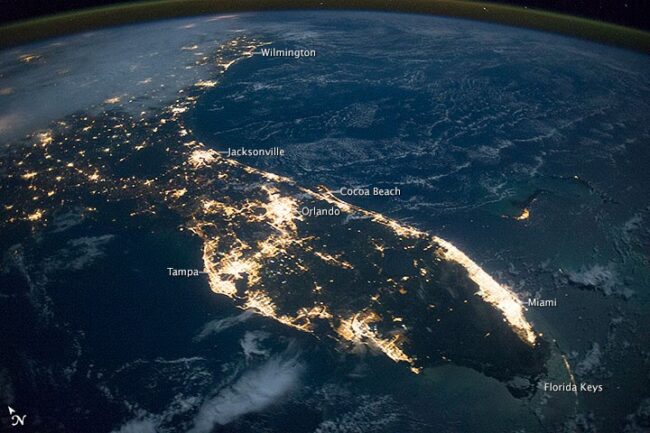
Photo: NASA Earth Observatory / ISS Expedition 41 crew. Public domain.
Quick Answer: Florida’s seasonally adjusted unemployment rate fell to 4.4% in September 2026, its fourth straight monthly decline from a 4.8% peak in April and May. Employers had 10,045,400 nonfarm jobs on payrolls, up 59,800 (0.6%) from a year earlier, but the state rate still sat 0.2 point above the 4.2% U.S. rate. October figures are due Nov. 20.
Florida’s job market has spent most of 2026 recovering from a rough first half. The statewide jobless rate climbed for more than a year, then peaked at 4.8% in the spring. Since then it has edged down one-tenth of a point each month. The September report, released by FloridaCommerce on Oct. 16 and confirmed in the U.S. Bureau of Labor Statistics state release on Oct. 20, is the most recent full set of state numbers as of Nov. 18. The BLS schedule puts October state data out on Friday, Nov. 20.
The headline improvement is real, but the details are mixed. Health care is doing most of the hiring. Finance, insurance, information and government are cutting jobs. And part of the drop in the unemployment rate comes from a shrinking labor force, not just from more people getting jobs. Here is what the latest data show and what they mean for Florida employers.
What was Florida’s unemployment rate in September 2026?
Florida’s seasonally adjusted unemployment rate was 4.4% in September 2026, down from 4.5% in August, according to FloridaCommerce and BLS. BLS listed Florida as one of only five states with a statistically significant drop in the unemployment rate from August to September. Florida, Nevada and Pennsylvania each fell 0.1 point.
The rate is still higher than it was a year ago. Florida’s rate was 4.2% in September 2025, so the latest reading is 0.2 point above that. BLS did not list Florida among the states with a statistically significant change over the year, so the yearly increase falls within the survey’s margin of error.
Is this the fourth straight monthly decline?
Yes. According to BLS Economy at a Glance data, Florida’s rate held at 4.8% in April and May, then fell to 4.7% in June, 4.6% in July, 4.5% in August and 4.4% in September. That is four straight declines of one-tenth of a point each, a total of 0.4 point since the peak. News Service of Florida coverage carried by WUSF and WLRN also described September as the fourth consecutive monthly dip.
| Month (2026) | Unemployment rate | Labor force | Unemployed |
|---|---|---|---|
| April | 4.8% | 11,149,500 | 531,700 |
| May | 4.8% | 11,144,600 | 531,400 |
| June | 4.7% | 11,139,000 | 524,500 |
| July | 4.6% | 11,120,700 | 514,500 |
| August | 4.5% | 11,114,700 | 502,400 |
| September (preliminary) | 4.4% | 11,113,900 | 488,900 |
Source: U.S. Bureau of Labor Statistics, Economy at a Glance: Florida (Local Area Unemployment Statistics, seasonally adjusted)
How does today’s rate compare with recent years?
The longer view shows how much ground Florida lost. Federal Reserve Bank of St. Louis data built from BLS figures put the state’s rate at 3.1% in January 2024 and 3.5% in September 2024. It reached 4.2% by September 2025 and 4.3% in November and December 2025. No October 2025 figure appears in the series. The rate then rose to 4.5% in January 2026 and 4.7% in March before topping out in the spring. WUSF reported in January that the rate was the highest in more than four years.
Why did the rate fall — more jobs or fewer job seekers?
Both played a part. From April to September, the number of unemployed Floridians fell by 42,800, from 531,700 to 488,900. Over the same period, household-survey employment rose by only 7,200, from 10,617,800 to 10,625,000. The labor force, meaning people working or looking for work, shrank by 35,600, from 11,149,500 to 11,113,900.
In other words, most of the decline in unemployment since spring came from people leaving the labor force, not from people finding jobs. September looked better than the months before it. Household employment rose by 12,700 from August while the labor force was nearly unchanged, and the number of unemployed fell by about 13,500.
Over the full year, the picture is more positive. News Service of Florida, citing FloridaCommerce, reported that the labor force grew by 21,000 from September 2025. The number of jobless residents rose by 28,000 over the same period.
How many jobs did Florida add over the year?
Florida had 10,045,400 nonfarm jobs in September 2026, up 59,800, or 0.6%, from September 2025, according to FloridaCommerce figures published by CareerSource Broward and CareerSource North Central Florida. From August to September, payrolls rose by 5,300, based on BLS Economy at a Glance figures. Nationally, jobs rose 0.3% over the year, per the same FloridaCommerce summary, so Florida’s job growth was about twice the national pace.
The trend in job growth has also improved. BLS data show Florida’s 12-month payroll growth was just 0.1% in April and May 2026. It reached 0.3% in June and July, 0.5% in August and 0.6% in September. That is slow by Florida’s historical standards, but it is moving in the right direction. BLS did not list Florida among the states with a statistically significant payroll change, either over the month or over the year.
| Key fact | September 2026 |
|---|---|
| Florida unemployment rate (seasonally adjusted) | 4.4% (Aug.: 4.5%; Sept. 2025: 4.2%) |
| U.S. unemployment rate | 4.2% (October: 4.1%) |
| Labor force | About 11.1 million |
| Unemployed Floridians | About 489,000 |
| Total nonfarm jobs | 10,045,400 |
| Job change over the year | +59,800 (+0.6%) |
| Major industries with job gains over the year | 6 of 10 |
| Next state release (October data) | Nov. 20, 2026 |
Source: FloridaCommerce; U.S. Bureau of Labor Statistics
Which Florida industries gained and lost jobs?
Six of Florida’s 10 major industry groups added jobs over the year. Education and health services led by a wide margin, adding 40,300 jobs, or 2.5%. News Service of Florida reported that nearly all of those gains came in health care and social assistance. That one sector accounted for about two-thirds of the state’s net job growth.
Professional and business services added 19,300 jobs, and leisure and hospitality added 16,800, a 1.3% gain that matters in a tourism-heavy state. Trade, transportation and utilities, Florida’s largest private industry group at 1,993,400 jobs, added 8,300. Construction added 3,300 and manufacturing added 2,100.
On the other side, financial activities lost 15,800 jobs, a 2.3% decline. News Service of Florida reported that the losses were larger in finance and insurance than in real estate. Government shed 8,900 jobs, mostly at the state and federal levels, according to the same coverage. Information lost 3,600 jobs, a 2.4% drop and the steepest percentage decline of any group. Other services lost 2,100.
| Industry | Jobs, Sept. 2026 | Change over year | Percent change |
|---|---|---|---|
| Education and health services | 1,637,200 | +40,300 | +2.5% |
| Professional and business services | 1,631,400 | +19,300 | +1.2% |
| Leisure and hospitality | 1,345,300 | +16,800 | +1.3% |
| Trade, transportation and utilities | 1,993,400 | +8,300 | +0.4% |
| Construction | 657,000 | +3,300 | +0.5% |
| Manufacturing | 428,900 | +2,100 | +0.5% |
| Other services | 383,300 | -2,100 | -0.5% |
| Information | 147,600 | -3,600 | -2.4% |
| Government | 1,141,700 | -8,900 | -0.8% |
| Financial activities | 674,000 | -15,800 | -2.3% |
Source: FloridaCommerce (over-the-year changes); U.S. Bureau of Labor Statistics Economy at a Glance (job levels, seasonally adjusted, preliminary)
Is construction recovering?
Slowly. BLS data show Florida construction employment fell over the year in April, May and June 2026, by 0.3% to 0.5%. It turned positive in July and reached a 0.5% gain by September, with 657,000 jobs. Monthly construction payrolls have been nearly flat all year, between about 655,500 and 657,000, so the sector is steady rather than growing fast.
Which Florida metro areas have the lowest and highest unemployment?
Metro-area rates are not seasonally adjusted, so they can swing with the seasons. In September, the Miami-Fort Lauderdale-West Palm Beach area had the lowest rate among the metros listed in News Service of Florida coverage, at 3.2%, down from 3.7% in August. Wildwood-The Villages had the highest, at 7.6%.
| Metro area | Sept. 2026 rate |
|---|---|
| Miami-Fort Lauderdale-West Palm Beach | 3.2% |
| Fort Walton Beach-Destin | 4.1% |
| Orlando | 4.2% |
| Tampa-St. Petersburg; Panama City | 4.3% |
| Jacksonville; Tallahassee | 4.5% |
| Pensacola; Melbourne | 4.6% |
| Naples; Sarasota | 4.7% |
| Daytona Beach; Gainesville | 4.9% |
| Lakeland | 5.2% |
| Sebring; Homosassa Springs | 6.3% |
| Wildwood-The Villages | 7.6% |
Source: FloridaCommerce data as reported by News Service of Florida; Orlando confirmed with BLS Economy at a Glance (not seasonally adjusted)
How are Central Florida and Orlando doing?
Orlando’s rate fell sharply, from 4.6% in August to 4.2% in September, according to BLS. The Orlando-Kissimmee-Sanford metro had about 1,507,700 nonfarm jobs, up 1.0% from a year earlier. That is faster than the statewide 0.6% gain. Orlando’s rate was 4.7% as recently as July.
What about South Florida?
CareerSource Broward’s summary of FloridaCommerce data shows wide differences among South Florida’s three big counties. Miami-Dade’s September rate was 1.9%, down from 2.9% a year earlier. Broward’s was 4.1%, and Palm Beach County’s was 4.4%. Miami-Dade’s labor force grew by 38,230, or 2.7%, over the year, while Broward’s shrank by 6,309.
Job growth also differed. The Miami-Miami Beach-Kendall division added 7,400 jobs (0.6%) over the year, led by professional and business services. The West Palm Beach-Boca Raton-Delray Beach division added 5,300 (0.8%), led by education and health services. The Fort Lauderdale division added just 300 jobs (0.1%).
News Service of Florida also cited a Florida Atlantic University report that found South Florida wages rising and new business formation strong, but job growth flattening.
How does Florida compare with the U.S.?
Florida’s unemployment rate was 4.4% in September, compared with 4.2% for the nation. According to the BLS state release, 20 states had rates significantly below the national rate in September. South Dakota had the lowest rate at 2.0%.
Nationally, the BLS reported on Nov. 6 that the U.S. unemployment rate was 4.1% in October and that employers added 165,000 jobs. BLS also revised the September national gain up to 60,000 from 29,000. Florida’s own October numbers will show whether the state kept pace.
Are layoffs rising in Florida?
Not by much, based on the latest weekly data. News Service of Florida reported on Nov. 12 that the U.S. Department of Labor estimated 5,047 first-time jobless claims in Florida for the most recent week, up from a revised 4,476 for the week ending Oct. 31. The 2026 weekly average is about 5,700, below the 2025 average of just over 6,100.
Formal layoff notices are also slightly lower than last year. In the first 10 months of 2026, FloridaCommerce received 220 Worker Adjustment and Retraining Notification notices covering about 16,000 layoffs, according to the same report. About 30% of those layoffs were tied to the early-May shutdown of Dania Beach-based Spirit Airlines. In the same months of 2025, the agency received about 250 notices covering nearly 17,500 layoffs.
What are small businesses saying?
The National Federation of Independent Business said its Uncertainty Index stayed well above its historical average, according to News Service of Florida coverage of the September report. Florida small business owners cited labor quality or availability as their top problem for the third consecutive month.
Brian’s Take
I’d call this a labor market that has stopped getting worse but hasn’t gotten healthy yet. Four straight declines in the jobless rate is welcome news. But from April to September, the labor force shrank by 35,600 while household employment grew by only 7,200. A rate that falls because people stop looking for work is a weaker signal than one that falls because people get hired. September was better on that score, and I’d want to see that hold up in the October report.
The industry mix is worth watching. Health care is carrying the state, adding about two-thirds of the net new jobs. Finance, insurance and information are shrinking. For business owners, that means hiring for clinical and service roles is still tight, while some experienced finance and tech workers may be easier to find than they were a year ago.
The regional spread also matters. Miami-Dade County at 1.9% and the Wildwood-The Villages metro at 7.6% are very different labor markets. A statewide average of 4.4% hides that. Employers making expansion or hiring plans should look at their own county numbers, not just the headline.
Frequently Asked Questions
What is Florida’s unemployment rate right now?
The latest official figure is 4.4% for September 2026, seasonally adjusted. It was released Oct. 16 by FloridaCommerce. October data are scheduled for release on Nov. 20, 2026.
How many people are unemployed in Florida?
About 489,000 Floridians were unemployed in September 2026, out of a labor force of about 11.1 million. That was 28,000 more unemployed people than a year earlier.
Is Florida’s unemployment rate higher than the national rate?
Yes. Florida’s 4.4% was 0.2 point above the U.S. rate of 4.2% in September. The national rate fell to 4.1% in October.
Which industry is adding the most jobs in Florida?
Education and health services added 40,300 jobs over the year, mostly in health care and social assistance. Professional and business services added 19,300 and leisure and hospitality added 16,800.
Which Florida metro area has the lowest unemployment?
Miami-Fort Lauderdale-West Palm Beach had the lowest metro rate in September at 3.2%, not seasonally adjusted. Wildwood-The Villages had the highest at 7.6%.
Sources and Further Reading
- Economy at a Glance: Florida — U.S. Bureau of Labor Statistics
- Economy at a Glance: Orlando-Kissimmee-Sanford, FL — U.S. Bureau of Labor Statistics
- State Employment and Unemployment, September 2026 — U.S. Bureau of Labor Statistics
- The Employment Situation, October 2026 — U.S. Bureau of Labor Statistics
- Release Schedule, November 2026 — U.S. Bureau of Labor Statistics
- Unemployment Rate in Florida (FLUR) — Federal Reserve Bank of St. Louis
- Broward County September 2026 Unemployment Data — CareerSource Broward
- FloridaCommerce Labor Market Update, September 2026 — CareerSource North Central Florida
- Florida’s unemployment rate dips for the fourth consecutive month — WUSF
- Florida jobless rate dips in September — WLRN / News Service of Florida
- Florida unemployment claims show slight increase — Florida Trend / News Service of Florida
About Brian French
Led by a commitment to tech-intelligent curation, Brian French tracks and analyzes breaking Florida Business Headlines and breaking corporate developments defining Florida's economy. Brian brings an extensive financial background to his analysis, having graduated from the University of South Florida in Finance and serving as a Vice President and Portfolio Manager for Merrill Lynch Private Investors and the Trust Department in St. Petersburg, FL, as well as a Vice President and Trust Investment Officer for SunTrust Bank in Sarasota, FL. His writing blends macroeconomic trends, fiduciary capital markets, corporate strategy, and modern digital insights for a sophisticated look at Florida's business market.